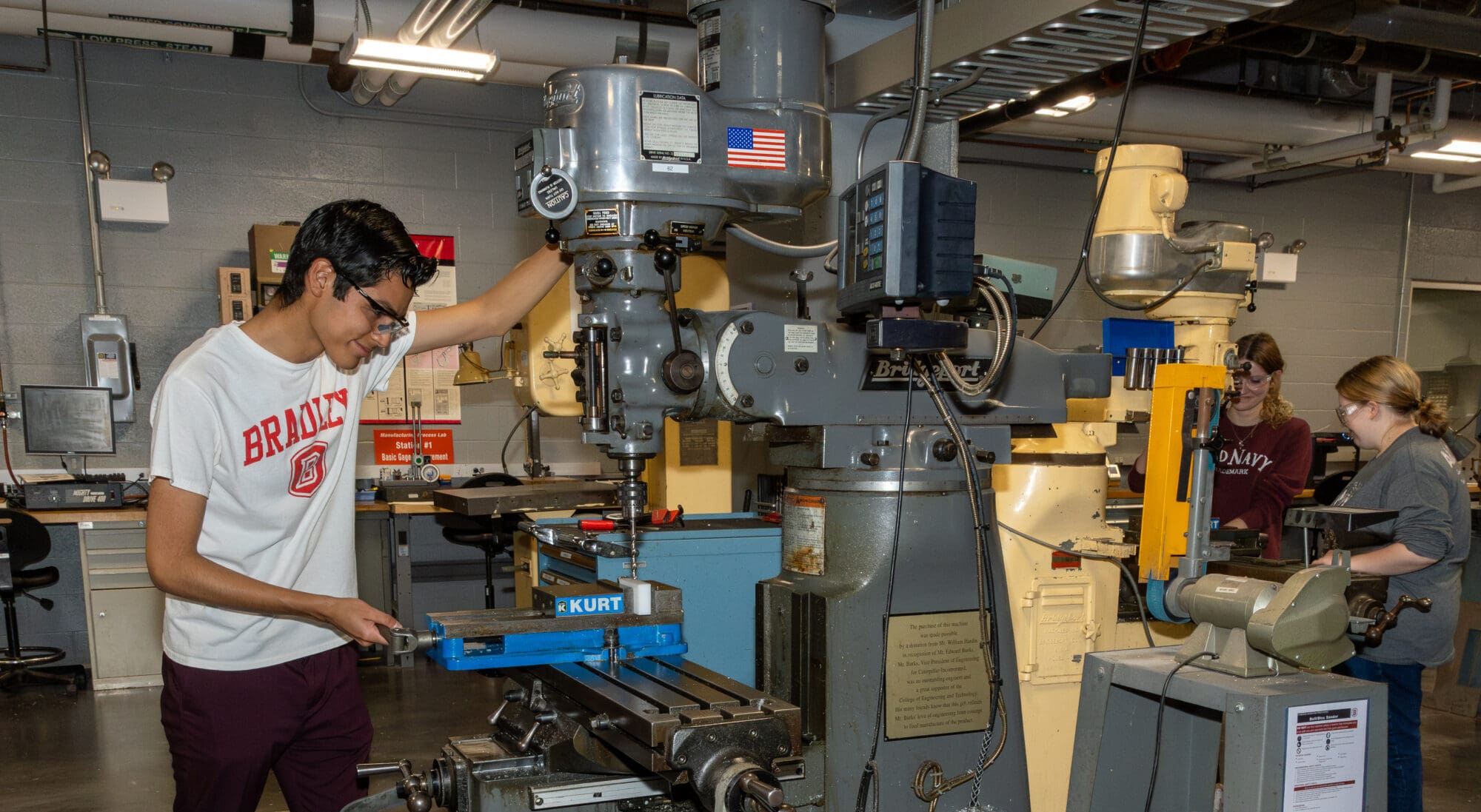
Manufacturing Engineering

What do you want to make tomorrow?

We live in a rapidly changing world. Who knows what new products will be in demand four or five years from now? From wireless Internet devices to automobiles that don’t use fossil fuel … we know that our future holds many new products. But who will manufacture them? You can — with a degree in manufacturing engineering from Bradley University.

Is Manufacturing for You?

Are you a tinkerer? Do you have intense curiosity? Do you like to take things apart and see how they are built? If so, a career in manufacturing may be right for you.

What do manufacturing engineers do?

Manufacturing engineers use complex systems, high-tech equipment, robots, and machines to convert a few pennies worth of raw materials into finished products hundreds of times more valuable. Be ready for the exciting world of manufacturing.

What skills are needed?

Manufacturing engineers draw upon a wide array of skills – math, science, and interpersonal. They also need good manual skills and an appreciation for things well made. Most of all, they need vision, creativity, and ambition.

Where can I work after graduation?

Bradley manufacturing graduates currently hold leadership positions at companies such as The Boeing Company, Caterpillar Inc., Deere & Co., Ford Motor Company, Motorola, and Hewlett Packard. Bradley's manufacturing graduates have an average starting salary exceeding $50,000 per year.

Program Curriculum

Process Engineering Concentration

Process engineering concentration would be aimed at providing the graduates with a strong set of knowledge and skills in product design, manufacturing processes, materials selection and design, automation, and manufacturing systems. The graduates would successfully function in industries such as automotive, aerospace, and heavy equipment manufacturers.

The unique courses for this concentration are:

IME 325 Transport Phenomena 3        
IME 441 Advanced Manufacturing Processes I or 3
IME 443 Advanced Manufacturing Processes II 3
IME 447 Advanced Joining and Fabrication 3
IME 495 Design for Manufacturability 3

Lean Manufacturing Concentration

Lean manufacturing concentration on the other hand would prepare the graduates to concentrate on creating more value with less work, through cost reduction by the elimination of waste in manufacturing. They would learn about principles like pull processing, perfect first-time quality, waste minimization, continuous improvement, six sigma utilization, flexibility, and production flow.

The unique courses for this concentration are:

IME 412 Design and Analysis of Experiments 3     
IME 466 Facilities Planning 3
IME 481 Lean Production Systems 3
IME 486 Logistics and Supply Chain Systems 3   

All students must complete the following classes.

Shown below is the recommended schedule for degree completion in four years:

Freshman Year
First Semester
IME 101 Introduction to Industrial & Manufacturing Engineering                       1             
IME 103 Computer Aided Graphics 2
MTH 121 Calculus I 4
CHM 110 General Chemistry I 3
CHM 111 General Chemistry I Laboratory 1
ENG 101 English Composition 3
Gen. Ed. Social Forces Economics 3
  Total: 17  
Second Semester  
IME 110 Intro to Computers & Computational Analysis                   3
MTH 122 Calculus II 4
PHY 110 University Physics I 4
COM 103 The Oral Communication Process 3
CHM 112 Engineering Chemistry 3
  Total: 17
Sophomore Year
First Semester
IME 301 Engineering Economy I                                             3
MTH 223 Calculus III 4
PHY 201 University Physics II 4
C E 150 Mechanics I 3
Gen. Ed. Human Values 3
  Total: 17
Second Semester
MTH 224 Differential Equations                                    3
CE 270 Mechanics of Materials 3
IME 386 Industrial & Managerial Engineering 3
IME 331 Fundamentals of Material Science 3
IME 341 Introduction to Manufacturing Processes 3
   Total: 15
Junior Year
First Semester
IME 302 Introduction to Quality Engineering                             3
IME 333 Materials Science Laboratory 1
IME 431 Materials Engineering 2
IME 395 Solid Model & Rapid Prototyping 3
Concentration Core (or) MFE Elective I 3
Gen. Ed. Western Civilization 3
  Total: 15
Second Semester
IME 362 Metrology and Instrumentation                                 3
IME 441 Advanced Manufacturing Processes I or  
IME 443 Advanced Manufacturing Processes II 3
Concentration Core (or) MFE Elective II 3
Gen. Ed. Social Forces 3
Gen. Ed. Fine Arts 3
  Total: 15
Senior Year
First Semester
EE 327 Fundamentals of Electricity & Electronics                       3
IME 445 Computer Aided Manufacturing 3
Concentration Core (or) MFE Elective III 3
Gen. Ed. Non-Western Civilization 3
Technical Elective 3
  Total: 15
Second Semester
IME 499 Senior Design Project                                            4
ENG 305 Technical Writing 3
Concentration Core (or) MFE Elective IV 3
Approved Technical Electives 3
  Total: 16
Total 127

Pre-requisite Flow Chart

MFE program pre-requisite flow chart

Program Educational Objectives

    Within five years into their careers, the graduates from the Manufacturing Engineering Program at Bradley University will have successful careers based on

    • Demonstrated ability to recognize manufacturing business problems and implement effective solutions.
    • Demonstrated ability to effectively lead cross-functional teams in the design, implementation and improvement of processes and systems.
    • Demonstrated professional development through continuous learning opportunities such as varied work assignments, graduate education, or professional associations.
    • Demonstrated involvement in service activities that benefit the profession or the community.

    Student Outcomes

    Manufacturing Engineering Graduates will have:

    • an ability to apply knowledge of mathematics and science to manufacturing processes, materials, project management, and design of manufacturing systems, emphasizing discreet piece part manufacture;
    • an ability to design and conduct experiments, as well as to analyze and interpret data related to manufacturing processes, materials evaluation, and manufacturing systems;
    • an ability to design, select and control a manufacturing system, its components or processes to meet desired needs;
    • an ability to function on multidisciplinary teams, an understanding of the concurrent approach to process and product development, and an ability to perform manufacturing project management;
    • an ability to identify, formulate, and solve manufacturing engineering problems considering constraints, costs, benefits and competitiveness of comparative processes and materials, through a hands-on approach.
    • an understanding of professional and ethical responsibilities of a manufacturing engineer;
    • an ability to utilize modern tools and techniques to effectively communicate technical requirements and functionality in oral, written and graphical forms;
    • the broad education necessary to understand the impact of manufacturing engineering solutions in a global and societal context;
    • the recognition of the need for, and an ability to engage lifelong learning;
    • a knowledge of contemporary issues facing engineers;
    • an ability to use techniques, skill and modern engineering tools necessary for manufacturing engineering practice utilizing supporting technologies including design for assembly, design for manufacturability, computer aided design, computer aided manufacturing and rapid prototyping.