


How These Bradley Alumni are Bringing History to the Big Screen
Bridging generations through bold filmmaking and impactful histories, these alumni are revolutionizing the way historic tales are told.
September 22, 2025
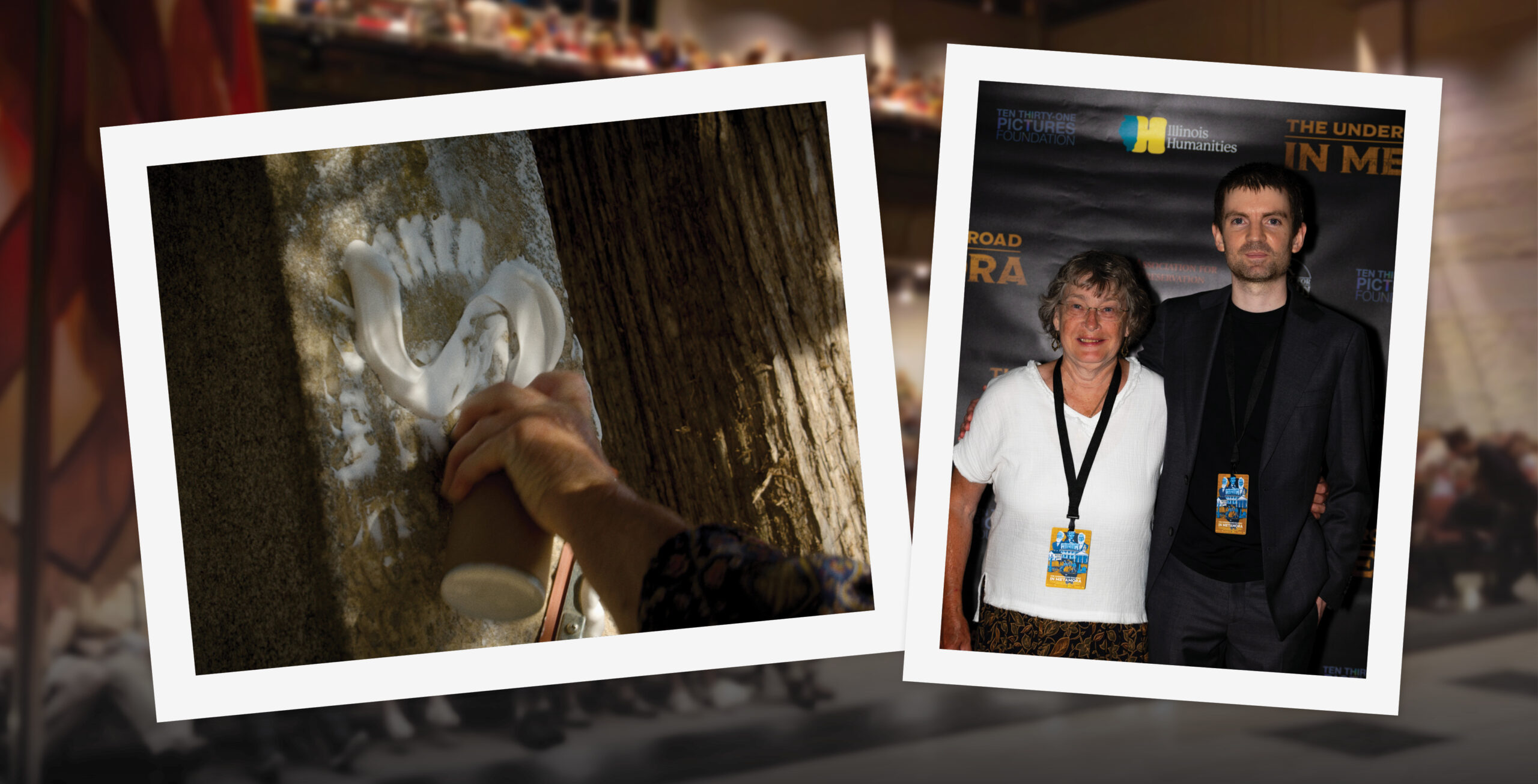
There was a sneaking sense of familiarity among the crowd during the world premiere of “The Underground Railroad in Metamora.” As the simmering sun beat down on the Kenneth H. Maurer Performing Arts Center inside Metamora High School, the bustling audience inside was awash with ‘Hey, how are ya’s and ‘Long time no see’s. As Levi Obery ’09 and Laure Adams ’85, ’90 GRD surveyed the scene, their pride was palpable.
“There was some familiarity and even camaraderie between members of the audience, and I think that’s partly a testament of Metamora being a small community where everyone knows each other,” Obery said. “While most of the attendees were from Metamora, we had visitors from neighboring communities and even out-of-state at the premiere. I think they were fascinated by this little-known, but significant part of Metamora’s history.”
This moment was a long time coming for Obery, who started a for-profit production company, Ten Thirty-One Pictures Entertainment, in 2002 and his non-profit, Ten Thirty-One Pictures Foundation, in 2024. He became interested in this part of history while working on a documentary with his grandmother about their family’s six-generation farm. In his research, he connected with Adams, the president of the Metamora Association for Historic Preservation (MAHP), as well as Jack Weddle, the organization’s treasurer. The more they talked, the more Obery knew there was another story to be told.
The documentary that resulted is an impactful look at the history of Metamora as a hub for freedom seekers and the conductors who helped them find shelter on their way to Canada. While the secretive nature of the conductors’ work meant a distinct lack of historical records, the documentary pulled together a broad swath of artifacts and information thanks to the partnership Obery made with Adams and the MAHP.
In one particularly unique scene about halfway through the movie, Adams showcases one of the many difficulties that come with the work of historical preservation. As the crew navigates gravestones of the conductors whose names have been worn away with time, she produces a can of shaving cream and a squeegee. At this point in the premiere, you could feel the audience collectively lean in.
Upon applying the shaving cream to the gravestones and wiping away the excess, the names suddenly became legible. Much of the documentary functions in the same way, creatively working around the limitations of time and secrecy to reveal a narrative–neighbors helping neighbors despite the mutual dangers.
“This ‘neighbors helping neighbors’ idea that is deeply rooted in the extreme risk that Metamora’s conductors took to simply do the right thing is still very much alive today in Metamora,” Obery explained. “The story intrigued me and is one that needs to be told, especially with everything going on in the world today. The theme of helping others simply because it is the right thing to do is something we must not lose sight of.”
Generations
Obery comes by his interest in history honestly. “My grandmother, Marcella Obery, had a particular interest in our family history and local history.”
So when he learned that the home of one of the prominent Metamora conductors, Norman Dutton, once stood on a piece of farmland that’s now part of his family’s farm, he was surprised and delighted.
“It’s an honor that my family owns a piece of this important part of Metamora history,” he said. “They’ve been finding remains of Dutton’s home while working in the field for years.”
As Obery’s documentary highlights, this direct connection to the past is not uncommon for the members of the Metamora community.
“In attendance at the premiere were descendants from several of the conductor families (Morse, Kern, Dutton, Ranney, etc.), some of whom traveled in from out of state. They are so proud that this story is being told,” Adams added.
Even Adams herself has a familial legacy she’s following. “My mother founded MAHP in 2000, and I became a ‘second generation’ president around 2012, focused on continuing the mission to promote and preserve the rich history of Metamora.”
Together, Obery, Adams, and their teams have produced a stunning historical document that can continue to inform for generations to come.
A Bradley Connection
“Laure and I were both instilled with a strong work ethic and take trust, honesty and integrity very seriously as a result of being brought up in the Metamora community. Bradley was an extension of that,” Obery said.
Interestingly enough, neither Obery nor Adams knew the other was also a Bradley alum before working together. However, no doubt inspired by their Bradley educations, their capacity to collaborate across disciplines meant they instilled trust in each other almost immediately.
“What worked so well on this collaboration was the unique strengths and perspectives that our organizations brought to the table,” Obery explained. “Laure and Jack brought their wealth of knowledge and extensive research on Metamora and the Underground Railroad, which was critical. I brought my background in film and video to ensure that this story was being told in the most compelling and professional way possible. It was really a team effort to get this project made.”
By the time their Bradley connection came to light, Obery and Adams were already confident collaborators. All the same, the skills they developed through their BU education were integral to the success of the project. Adams cited her organization and task management skills as a direct result of her MBA studies at Bradley.
“Bradley, and in particular the Entrepreneurship program, prepared me professionally for projects like ‘The Underground Railroad in Metamora’ because of the emphasis on practical experience and its collaborative environment,” Obery said.
As they look to the future of both the documentary and the history it shares with so many other communities, both Obery and Adams hope this production provides a template for other communities to research and tell their Underground Railroad story.
“With the recent government funding cuts to arts organizations, if viewers would like more stories like these told, and not just by our organization, it’s important to contact your local lawmakers and contribute to these organizations directly if you can.”
More information on “The Underground Railroad in Metamora” can be found at tenthirtyone.org.
–Jenevieve Rowley-Davis