


No Plan, No Limits: How a Bradley Grad Found His Calling in Wood
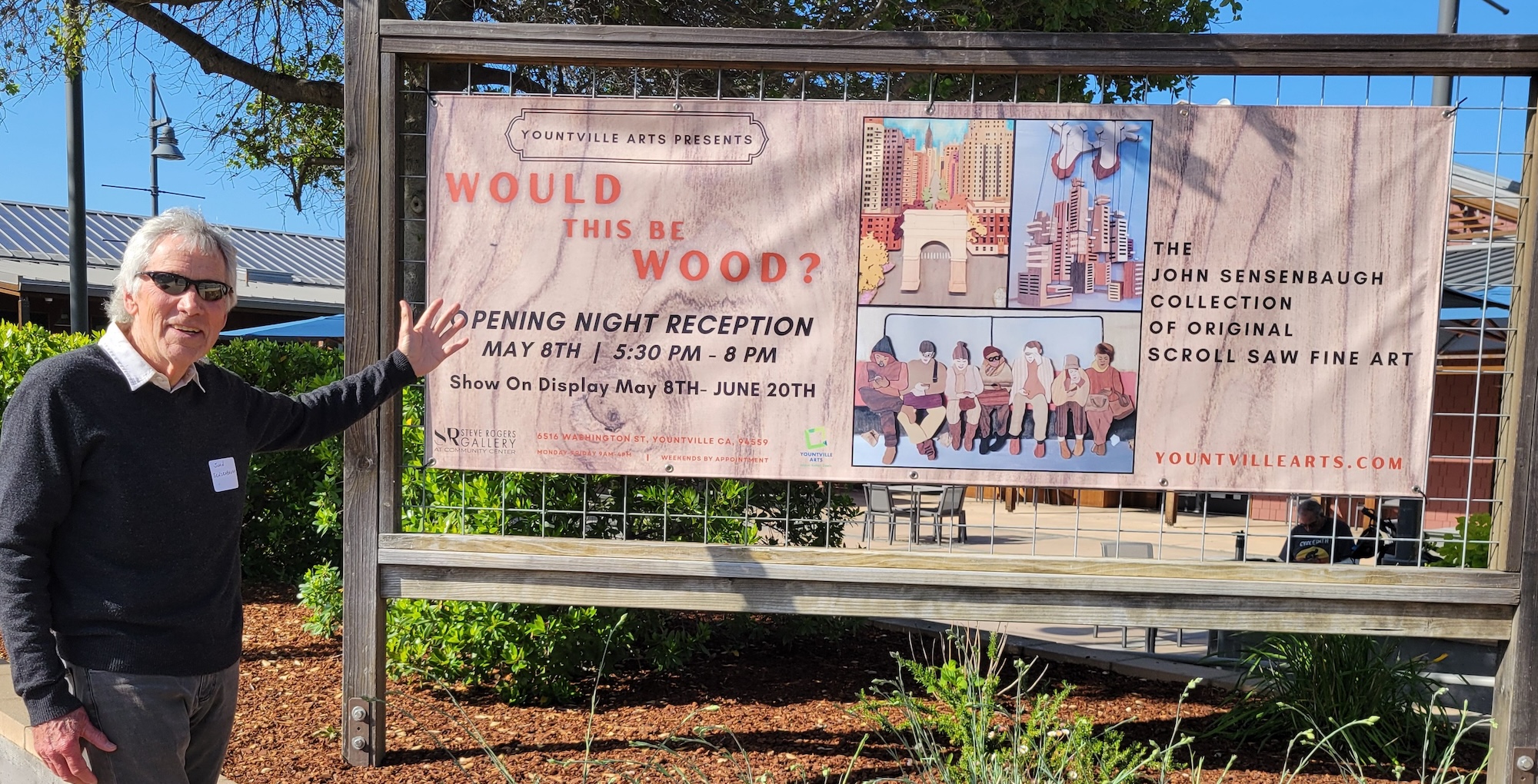
When John Sensenbaugh ’71 graduated from Bradley with an accounting degree, he had one clear goal—and it wasn’t his career. He wanted to move to California.
“I declared accounting as my major, but it definitely wasn’t because I had a burning desire to become an accountant. My father wanted me to enroll in an engineering discipline, but I had absolutely no interest or aptitude in that,” Sensenbaugh said. He declared accounting as a compromise with his father, who saw it as a practical path—even if Sensenbaugh didn’t.
Within weeks of graduating, he began planning his move west, and a year and a half later, he arrived in Sacramento with no job, no savings, and no place to live—just determination. “The last thing I wanted was to come back home with my tail between my legs.”
He survived and never looked back. Over the next several decades, Sensenbaugh dabbled in real estate development and owned and operated a few small businesses. He moved to Napa five years after landing in Sacramento and has been there ever since. Though he never worked as an accountant, his degree opened doors—and later proved invaluable when he owned and managed small businesses.
But his most unexpected chapter began not in business, but in wood.
Discovering a Hidden Talent
Shortly after moving to California, Sensenbaugh worked for a man who made furniture out of recycled wood, sparking his interest in the medium. “He taught me how to use different saws and woodworking tools,” he explained. “I have been dabbling in making things out of wood for some time—outdoor furniture, toys, and little desktop trinkets,” he said. A friend later introduced him to a power tool called a scroll saw, and it changed everything.
Discovering the scroll saw opened the door to intricate, detailed work, far beyond what he could achieve with traditional tools. He began experimenting more, and he made his first work that he deemed suitable to hang on the wall, and from there he was off and running.
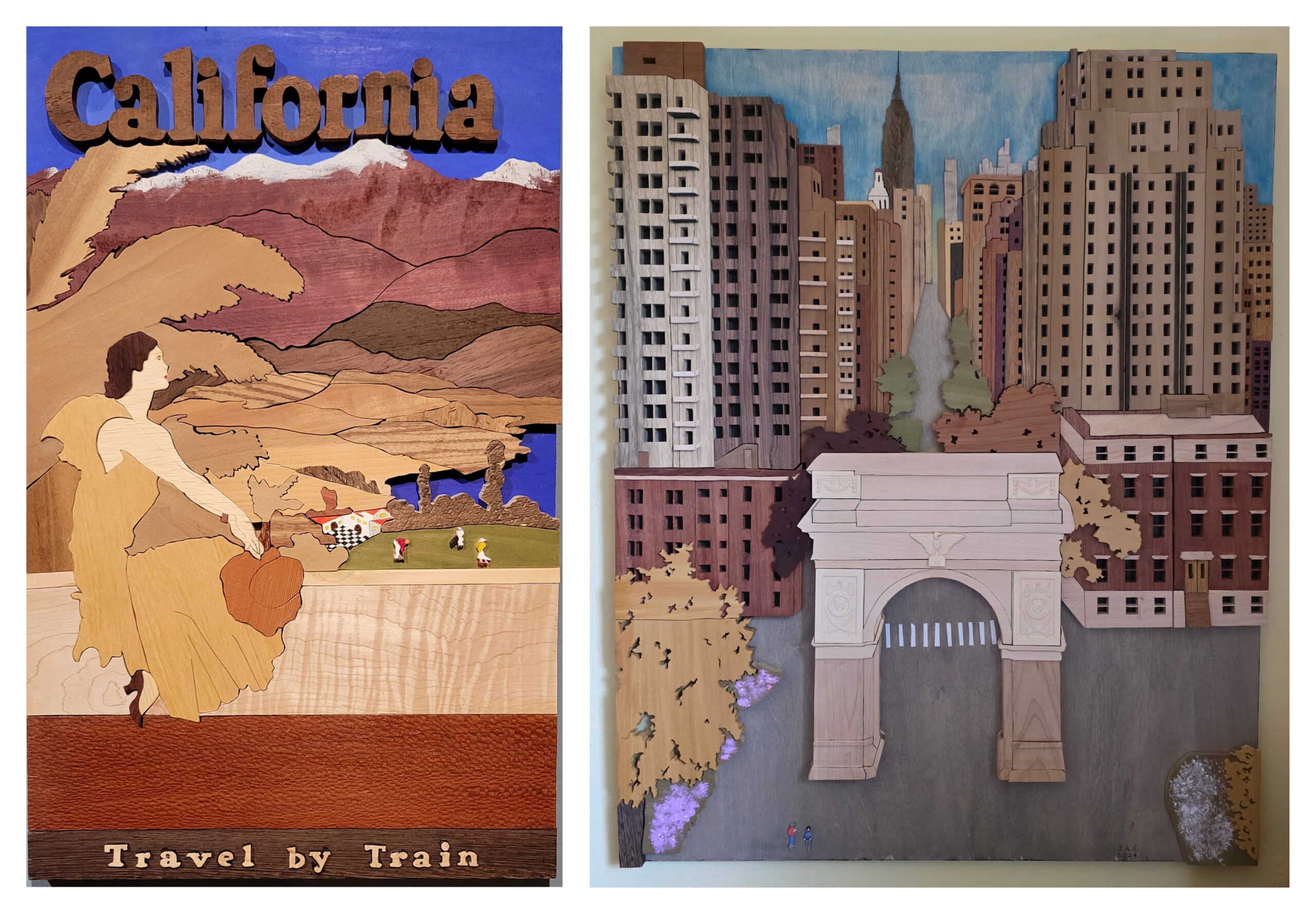
Two of Sensenbaugh’s works: Travel by Train and Washington Square Park.
Sensenbaugh works with about two dozen wood species from Africa, South America, and the U.S., attracted to the various colors and grains. He cuts and joins the pieces of wood together like a jigsaw puzzle, fabricating one-of-a-kind creations. The natural hues of the wood as they “come out of the ground,” as he described, are what drives him to create his art pieces. “It is amazing to me how many different colors of wood there are. I sometimes use stains to enhance the colors, but most of the time, the color is the wood itself.” He also uses acrylic paint for details in people’s faces in his work.
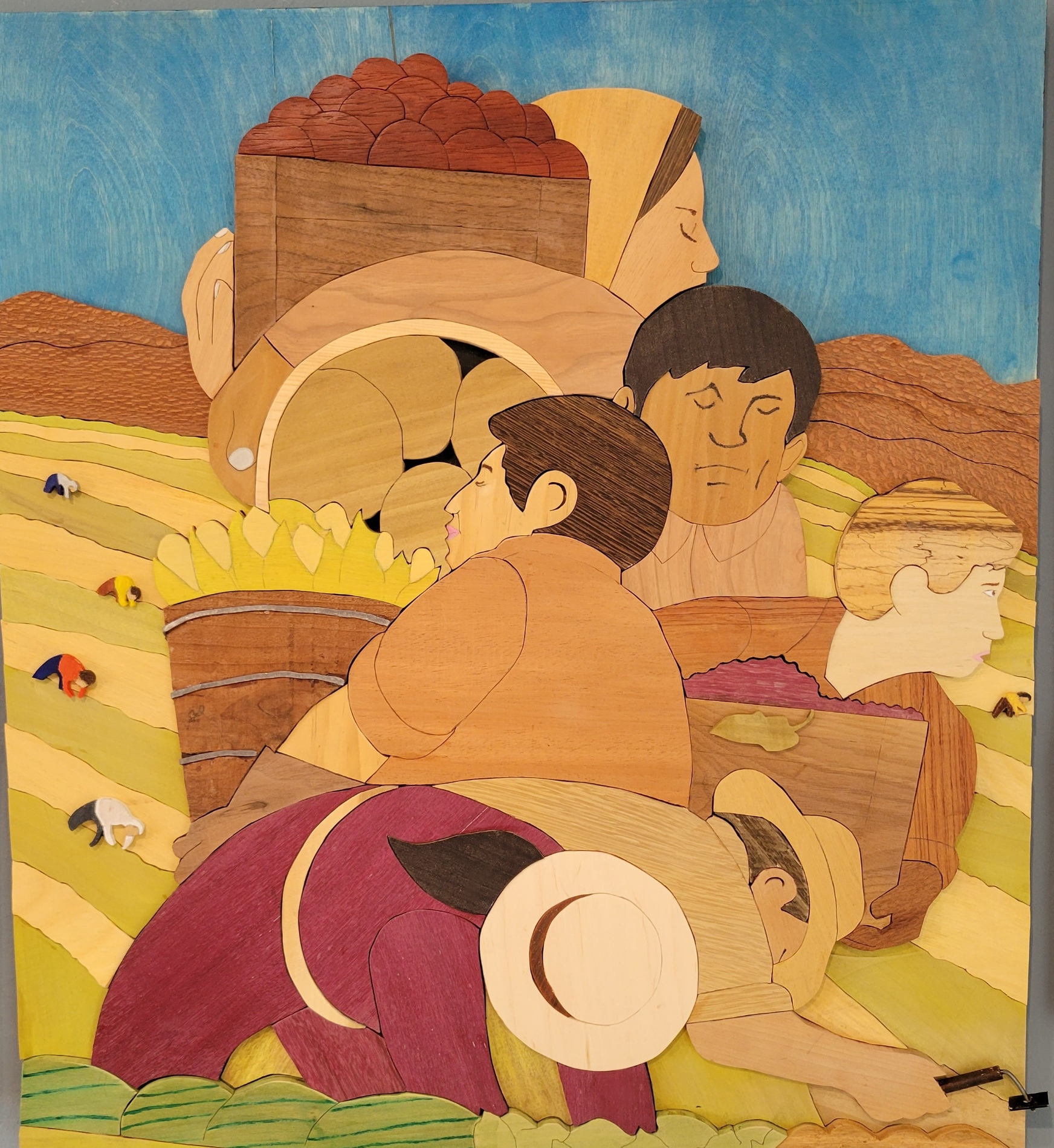
“‘Where Our Food Comes From’ is a reminder of how much we depend on these very important workers who toil doing very hard work for very little pay, often in brutally hot weather,” says the artist.
“Before I cut a piece of wood, I think about how it will fit with the piece that’s adjacent to the one that I previously cut. I get my inspiration from photographs, old movie posters, the travel industry, the Art Deco era, and from traditional artist’s paintings,” Sensenbaugh explained.
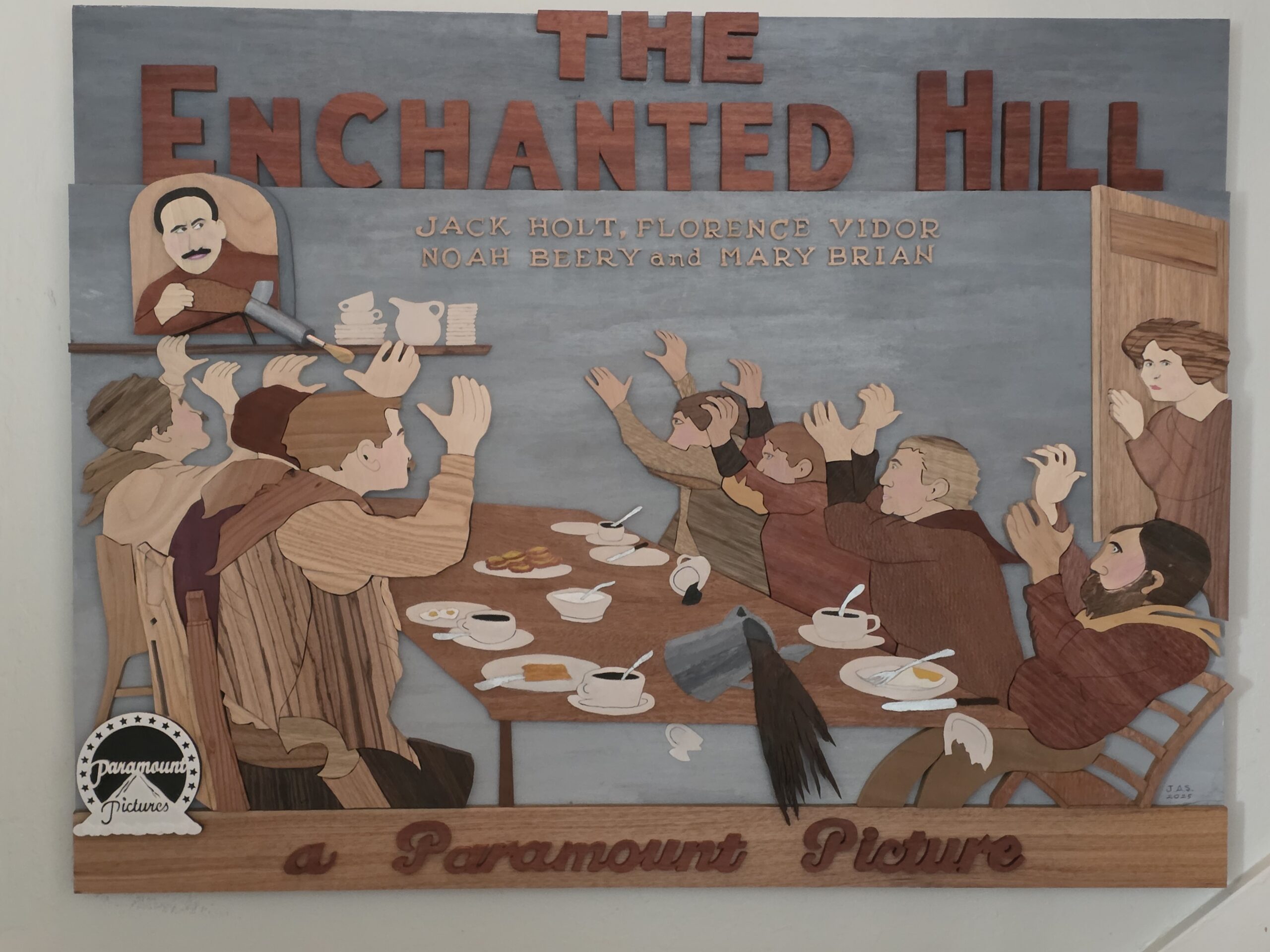
His rendition of the poster for the 1926 silent movie, “The Enchanted Hill.” The Paramount Picture logo at the bottom was created with a 3D printer.
Last year his work was featured in two one-man exhibitions, the biggest being the annual “Art, Sip, and Stroll” in Yountville, which is in the center of the Napa Valley. “It was a big honor and thrill for me. The organizers asked me to bring my scroll saw to the gallery and demonstrate my technique, which I was very happy to oblige,” Sensenbaugh said. “I especially enjoyed cutting little samples of wood for children who would draw a design on it.”
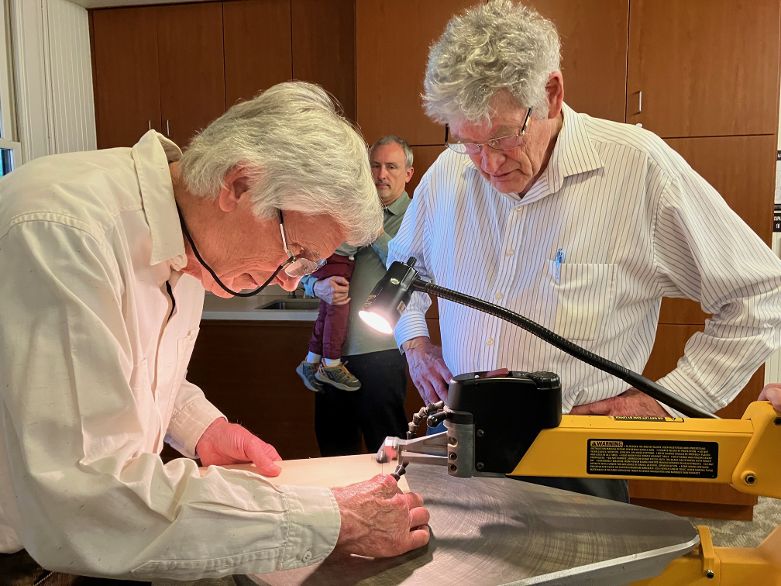
Here here demonstrates his scroll saw technique.
Much of Sensenbaugh’s life has been shaped by instinct rather than a set plan—moving west without a safety net, building businesses along the way, and ultimately discovering an artistic voice in wood. What began as a leap of faith has become a life defined not by certainty, but by curiosity, resilience, and the willingness to see where each path might lead.
Today, each piece he creates reflects that same spirit of exploration carefully assembled, shaped over time, and uniquely his own.
—Emily Potts