



The Bradley Core Curriculum (BCC) provides every student with common understandings and skills that transcend and enrich specific degree programs. The breadth of these courses across disciplines helps students situate their personal and professional selves within the complex and interconnected global society in which they will live and work. These skills support student success in both their academic careers at Bradley and in their lives after graduation. In essence, the Bradley Core Curriculum lays the foundation for a lifetime of intellectual development.
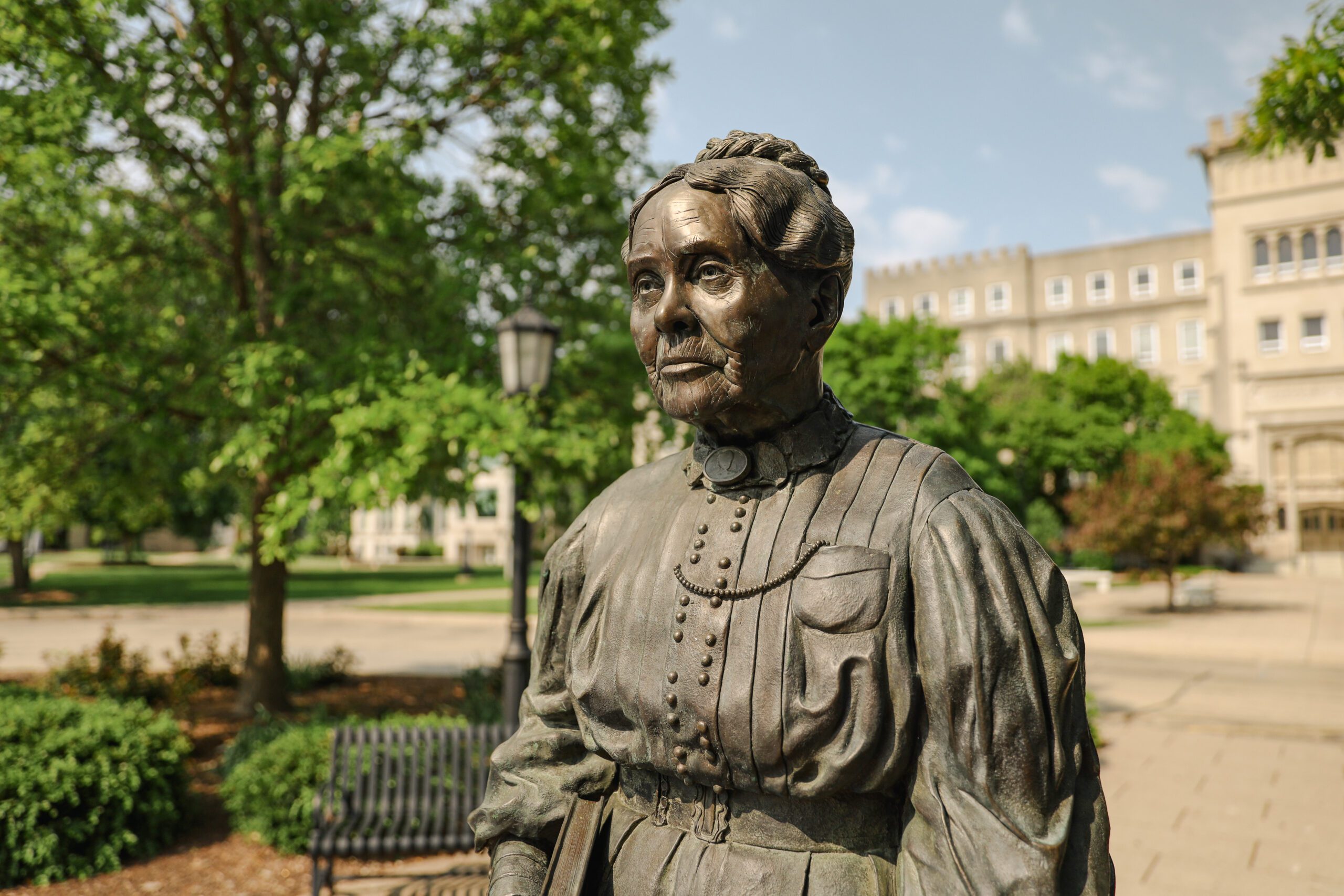
More specifically, the BCC advances Lydia Moss Bradley’s intent that the university “furnish its students with the means of living an independent, industrious and useful life” by equipping them with a common set of attributes, understandings and tools to:
- Make connections between thoughts, ideas and people through more emphasis on
collaboration, critical thinking, decision-making and inquiry across disciplines and
cultures; - Become better communicators with the integrative, reflective and multidisciplinary
mindset necessary in today’s global society; and - Embrace the flexibility of a customizable Bradley Experience by pursuing the subject
areas that best support or complement their individual interests, abilities and future
plans.
What You’ll Take:
Through 12 courses across eight areas of inquiry—plus two writing intensive and two experiential learning opportunities—you’ll grow as a thinker, problem-solver, and communicator.
Areas of Inquiry
- Communication (3 courses: speech, composition, upper-level writing)
- Fine Arts
- Global Perspectives
- Humanities
- Natural Sciences
- Quantitative Reasoning
- Social & Behavioral Sciences
- Multidisciplinary Integration
- 2 electives to round out your journey
In addition to the Areas of Inquiry, the full Core Curriculum experience includes a set of two “Core Practices”: Writing Intensive (WI) courses and Experiential Learning (EL) Experiences.
Communication (CM)
Bradley graduates will be effective verbal and written communicators. Bradley graduates, as creative and critical thinkers, will communicate effectively in their personal and professional lives. Writing and reading are essential skills that must be continually strengthened. Oral communication is similarly critical to effective formal and informal interaction. Effective communication is vital to ethical and sustainable societies.
In the Communication Area of Inquiry, students must select one course that focuses on Oral Communication (OC) and two courses that focus on Writing (W1 and W2). Students are encouraged to take the OC and W1 courses during their first year and the W2 course no later than their junior year.
Curricular Elements
- CM1 Understand the processes and functions of human communication.
- CM2 Communicate skillfully with attention to audience, cultural differences, clarity, logic, coherence, evidence and style.
- CM3 Listen and read with interpretive and analytical proficiency.
- CM4 Give and receive constructive criticism in a collegial environment.
- CM5 Differentiate between ethical and unethical communications, including one’s own.
Fine Arts (FA)
Bradley graduates will understand and appreciate the arts as a vital human experience interwoven with other humanistic disciplines. The fine arts span the entirety of human history, influencing, reflecting and documenting profound experiences of individuals and cultures. Their dynamic evolution necessitates an understanding of how classical foundations inform modern expression. Informed aesthetic judgments contribute to the creation of dynamic living and working environments and new media and technologies. Through knowledge and experience of aesthetic principles, Bradley graduates will gain a deeper understanding of themselves and an appreciation for the socioeconomic impact of the arts and design.
Curricular Elements
- FA1 Demonstrate knowledge about essential historical and contemporary contributions of the arts and use that knowledge to articulate the significance of the arts as vital human and cultural expressions.
- FA2 Develop an appropriate vocabulary of theoretical concepts, techniques and goals inherent in artistic expression and apply that vocabulary to describe artistic experiences.
- FA3 Identify and reflect on characteristics of individual art forms as well as shared elements across a representative selection of performing, visual, literary, interactive and emerging arts.
- FA4 Engage the arts with sensitivity and knowledge so as to incorporate the arts into their professional disciplines and personal lives.
Global Perspectives (GP)
Bradley graduates will enhance their global perspectives by becoming knowledgeable about global systems, the forces that shape those systems and cultures of the world. Communication technologies, economic relationships and the flow of people across national borders have created an increasingly interconnected and interdependent world. Yet, having grown up in a time when one country has demonstrated unprecedented political, economic and cultural influence around the globe, students can have a difficult time understanding how other cultures and societies are distinct from one’s own or how others might take a negative or confrontational view of one’s own culture or society. For these reasons, a well-developed global perspective that includes understanding of the human and natural systems that shape our individual and common futures and the diverse peoples of the world is essential for life in the 21st century.
In the Global Perspectives Area of Inquiry students may select courses that focus on either global systems or world cultures. Students who complete two courses in this Area of Inquiry are strongly recommended to select both a global systems course and a world cultures course. Not only are global systems and world cultures complementary components of a comprehensive global perspective, but also completion of both types of courses furthers the general education goal of increasing each student’s breadth of knowledge.
Global Systems (GS)
Bradley graduates will understand global systems — the political, economic, social, technological and ecological interconnectedness of our current global society. They will also understand the forces shaping these systems and the relevance of these systems for their local and national communities. This knowledge is essential for participating effectively in the interactions that characterize an interdependent world.
Curricular Elements
- GS1 Recognize and appreciate the complex interconnections and interdependence of global political, economic, social, technological and ecological systems.
- GS2 Identify, analyze, interpret and synthesize the forces that shape evolving global systems and the resulting impacts of those forces and systems on current and future world events.
- GS3 Be able to discuss key ways in which contemporary global systems and issues impact individuals and their communities.
- GS4 Relate global systems to an increasingly complex work, civic and personal environment and explore ways as responsible individuals to address global issues, e.g., political, economic, social or environmental problems of worldwide scope.
World Cultures (WC)
Bradley graduates will study and analyze various contemporary world cultures, including their historical development, institutions, values, art and religion. Knowledge of multiple cultural perspectives introduces alternate ways of thinking and strengthens one’s ability to relate to others. The understanding of diverse cultures is essential for engaging productively in our globalized society and contributing to the welfare of humanity. An important goal is to have students experience other cultures and to use what they learn about others’ experiences to reflect critically on their own ways of understanding the world.
Curricular Elements
- WC1 Understand the values, attitudes, social structures, politics, artistic practices, religious traditions, languages, literatures or histories of (1) multiple cultures or countries or (2) a single culture or country analyzed within a regional, transnational or global context.
- WC2 Understand issues of cultural difference, ethnocentrism, intolerance and cultural conflict.
- WC3 Develop skills for working as ethical, compassionate, non-ethnocentric actors with the dynamic forces at work in an increasingly diverse and globalized society.
Study Abroad – The World Cultures component of Global Perspectives can be satisfied by either completing an approved World Cultures course or by completing a full academic semester (12 hours minimum) or year abroad. While many students completing a full semester study abroad program will take courses that qualify as World Cultures courses this is not required. Because a full academic semester abroad comprises a significant cultural experience, it will satisfy the World Cultures requirement without additional course work.
Humanities (HU)
Bradley graduates will think reflectively about the human condition, understand the forces that have shaped human history and ponder perennial ethical, religious and existential issues. Study of the humanities is fundamental to leading an informed and reflective life, which contributes directly to students’ present and future lives as civically engaged, critically thoughtful, aesthetically cultured and ethically minded individuals.
The Humanities Area of Inquiry seeks to uniquely address Lydia Moss Bradley’s commitment to ethical learning through a critical examination of values. The study of values focuses on intellectual justifications of the aims, goals and ideals that guide human conduct. The humanities, through the study of history, literature, philosophy and religious studies, help students to better understand themselves, their communities, nations and the world through the focal lens of the human experience.
- Through the study of history, students learn about the complexities of the past and patterns of change, and are thereby better able to understand contemporary events and developments.
- Through the study of literature, students learn broadly and deeply about the human condition, diverse cultures and times, and the relevance and power of literary works produced by the creative imagination.
- Through the study of philosophy, students are aided in analyzing some of the fundamental questions regarding life and human experience.
- And through religious studies, students learn about religious experience as well as those sacred beliefs and practices that have been central to cultures throughout time.
The Humanities Areas of Inquiry is one in which students have the option of completing one or two courses. Humanities faculty strongly recommend that students taking two courses in Humanities select courses from two different subjects — history, literature, philosophy or religion.
Curricular Elements
- HU1 Develop the skills of historical, philosophical, religious, and/or literary analysis in relation to human values and ethical decision-making.
- HU2 Engage in sustained and critical reading of diverse literary, philosophical, religious and/or historical works.
- HU3 Learn how historical, cultural, philosophical and/or religious factors have shaped perceptions, values and actions, individual and collective identities, and communities and cultures.
- HU4 Foster the ability to communicate articulately about historical events, philosophical ideas, religious beliefs and practice, and/or diverse literary works.
- HU5 Foster students’ abilities to make responsible and productive choices as civically engaged, critically thoughtful, aesthetically cultured and ethically minded citizens.
Knowledge and Reasoning in the Natural Sciences (NS)
Bradley graduates will develop scientific reasoning skills supported by an integrated knowledge of the natural sciences to interpret technical information with the sophistication necessary to be contributing members of a knowledge-based society. Curiosity about the natural world and recognition of the rapidly expanding body of scientific information are essential to success and fulfillment in contemporary society.
Curricular Elements
- NS1 Recognize science as an ongoing process, guided by ethical standards of practice, that generates and refines knowledge.
- NS2 Engage in multiple aspects of the scientific process.
- NS3 Apply scientific principles in their personal and professional lives as active members of their communities.
Knowledge and Reasoning in the Social and Behavioral Sciences (SB)
Bradley graduates, as constructive and responsible members of society, will understand themselves in relation to others and to social institutions. Essential to this relationship is an understanding of the economic, political, psychological and social dynamics that shape contemporary society. Individuals equipped with methods of inquiry and analysis in the social and behavioral sciences, an understanding of how social forces interact and a foundation in ethics can participate effectively and ethically in political processes, markets and social institutions at local, national and global levels.
Curricular Elements
- SB1 Articulate social and behavioral theories of the factors that shape society.
- SB2 Recognize the assumptions and supporting evidence for social and behavioral theories.
- SB3 Apply knowledge from the social and behavioral sciences to social issues and problems.
- SB4 Describe the reciprocal relationships between individuals and social communities.
- SB5 Acquire knowledge of the standards that social and behavioral scientists use for evidence-based inquiry in the gathering, evaluation and presentation of information.
- SB6 Recognize ethical issues that arise in the social and behavioral sciences.
- SB7 Describe the connections between the various social and behavioral sciences.
- SB8 Gain the skills and knowledge necessary to apply lessons learned from the social and behavioral sciences in their everyday behavior at work, at home and in their communities.
Multidisciplinary Integration (MI)
Bradley graduates will understand the value of integrating knowledge, skills and approaches to inquiry across disciplinary boundaries. The Bradley Core Curriculum exposes students to different disciplinary perspectives and ways of knowing, but students must also see the connections between the existing bodies of human knowledge and schools of thought and be able to integrate them. The practical demands of employment and research in a dynamic, diverse, specializing and globalizing world point to the importance of experience with multidisciplinary problem-solving and teamwork. More importantly, complex problems in modern society require the integration of knowledge and techniques from multiple disciplines.
Courses that promote critical thinking and problem-solving across multiple disciplines can take a variety of forms, ranging from a critical exploration of a broad theme from multiple perspectives to a multidisciplinary capstone course.
Examples of best practices for pedagogy in this category include but are not limited to the following:
- First-year seminars that explore complex issues or emerging areas of research that bridge two or more disparate fields of study.
- Lower-division courses that critically examine broad themes by incorporating the scholarly traditions and methods of inquiry from multiple disciplines but require little or no pre-requisite knowledge.
- Upper-division courses that tackle complex issues requiring some background knowledge in one or more of the fields of study that are being integrated.
- Capstone courses that demand collaborative problem-solving or scholarship across disciplines.
Curricular Elements
- MI1 Connect knowledge, standards and perspectives from two or more disparate fields of study to explore broad themes or complex problems.
- MI2 Adapt and apply skills, abilities, theories or methodologies gained from two or more disparate fields of study to create a deeper understanding of a complex topic or solve complex problems.
- MI3 Acquire and use a shared vocabulary that allows communication across disciplinary boundaries.
- MI4 Articulate how integrating two or more disparate fields of study enables novel insights or deeper understanding of complex problems.
Quantitative Reasoning (QR)
Bradley graduates will understand and effectively engage in formal reasoning and applied quantitative reasoning. The ability to reason logically is essential for success in society and provides opportunities for intellectual fulfillment. Experience with formal reasoning helps students develop as critical thinkers who approach their choices and actions with careful thought. In today’s data-drenched society, substantial quantitative reasoning skills are increasingly necessary for an educated member of society. In order to act effectively as citizens, students must be familiar with how quantitative information and methods are properly used when making persuasive arguments.
Curricular Elements
- QR1 Apply structured inquiry, problem-solving skills and creative thought when pursuing practical and abstract investigation.
- QR2 Interpret information presented in mathematical forms (e.g., equations, graphs, diagrams, tables, words).
- QR3 Convert relevant information into various mathematical forms (e.g., equations, graphs, diagrams, tables, words).
- QR4 Use quantitative means (e.g., algebraic, geometric, and statistical methods) to solve problems.
- QR5 Recognize the appropriateness and limitations of mathematical and statistical models.
- QR6 Identify and evaluate important assumptions in estimation, modeling and/or data analysis.
- QR7 Make judgments and draw appropriate conclusions based on the quantitative analysis of data.
- QR8 Recognize issues related to the valid and ethical use of quantitative information.
- QR9 Appreciate the intrinsic value of mathematical inquiry while supporting and deepening quantitative literacy within society.
- QR10 Develop mathematical reasoning and problem-solving skills in settings the college graduate may encounter in the future.
Writing Intensive (WI)
Writing Intensive (WI) courses allow faculty across the university to help students advance their writing skills in the context of specific disciplines. WI is a recognized high impact practice that allows faculty to adapt student writing to professional practices, such as collaborative projects. For example, in Biology WI courses, students will learn to write as biologists; in business WI courses, students will learn the conventions of writing in business contexts. Students can take WI courses in a variety of disciplines—every college offers WI courses.
Curricular Elements
- WI1 Students improve as writers: Instructors help students cultivate writing processes by developing effective strategies for generating ideas, gathering information, drafting, revising, and editing. Instructors integrate writing practice and instruction into the processes of instruction and learning. Writing is an extension of thinking, allowing students to reflect on and process what they are reading and learning, and so to better learn and integrate course content with intentionality.
- WI2 Students will use writing to articulate content knowledge in the discipline:Instructors engage students in the practice of writing as an extension of learning and thinking about course content. In order to perform as an experienced member of a disciplinary community, students will learn how to read and write like professionals in the field. Instructors teach writing forms, conventions, and practices of the field of study of the course. Different fields or disciplines have different writing forms, practices, and conventions.
- WI3 Students demonstrate ability to write for a discipline-specific audience: Instructors teach students that academic writing in all disciplines involves the incorporation of sources external to the writer and/or reflection on the writer’s own thoughts, ideas, and experiences. To further achieve an understanding of the field, students must be exposed to a variety of sources of information and taught the conventions of the discipline or field for incorporating that information into their written work.
- WI4 Students purposefully modify written work based on the feedback process: Instructors teach writing as a process requiring cycles of feedback and revision. Through this process, students are challenged to more clearly articulate, elaborate, and otherwise refine their ideas and their expression of those ideas.
In addition to the Curricular Elements, WI Courses also fulfill the following requirements:
- To receive a WI tag for a course, instructors must indicate how their course will meet the spirit of these four curricular elements.
In addition, instructors must indicate how they will meet the following mechanical requirements:
- Writing feedback and revision: At least one major assignment must employ the draft/rewrite process, wherein the instructor provides feedback on the writing to the student, who then submits a revision or second product. This requirement may be met by a series of short writing assignments (e.g. lab reports; weekly essays) on which the instructor gives feedback on written work that the student then applies to subsequent assignments.
- Writing assignments and rubrics: Each writing assignment and its purpose must be clearly described in the syllabus, along with the criteria by which students’ writing for the assignment will be assessed. In addition, some class time must be dedicated to explaining each writing assignment and the assessment criteria. The instructor should do their best to help students understand what they need to do in order to produce “A” work, and what differentiates an “A” paper from a “C” paper or an “F” paper.
- Instruction in writing: Some class time must be dedicated to explicit instruction in writing. Often, this will include, but need not be limited to, discipline-specific conventions and practices.
- Writing quantity: The course must include at least 5,000 words of writing per student, including drafts. For courses that involve collaborative writing assignments, there must be a significant portion of the total writing attributable to individual students.
- Percentage of course grade: Writing assignments will comprise at least 25% of the course grade, and essay exams may count for no more than 30% of the 5000-word writing minimum.
In addition, the following two items are strongly recommended for all WI-tagged courses:
- Partnership with the library: Faculty members are encouraged to consult with librarians as to how they might incorporate library resources (e.g. Open Educational Resources; scaffolding of assignments; Diversity, Equity, and Inclusion resources). Librarians will help students identify the resources appropriate to their field, such as literature sources and databases. This element could be part of class time instruction, a specified homework assignment, or an out-of-class activity/assignment. If the course does not require the use of library-based information resources, the instructor applying for a WI tag for a course needs to explain this in their proposal.
- Maximum class size: The course should have a maximum of 25 students per section. Exceptions must be explained and justified.
The WI courses list will not always be offered as WI in any given semester. To be sure that your course will be offered as WI, you must check the Schedule of Classes at the time you enroll.
Experiential Learning (EL)
The Bradley Core Curriculum requires that students participate in two or more courses or registered experiences that have been designated as Experiential Learning (EL). Experiential Learning is a high impact practice that is at the heart of the Bradley Experience. Students will learn to apply knowledge, skills and dispositions to real-world applications within and beyond the classroom. These activities provide students with an awareness and appreciation of their growing ability to apply learning to problems that will be encountered after Bradley. Experiential Learning commonly encompasses a variety of experiences that can include service learning, study abroad, supervised research or creative production, capstone experiences, or supervised internships and practical experiences. Additional manifestations of Experiential Learning may be approved.
Curricular Elements
- EL1 Intention: The course or activity must have intentionality. Intention represents the purposefulness that enables experience to become knowledge. Learning goals/objectives, and aligned activities must be discussed and approved prior to the experience.
- EL2 Preparedness: The course or activity must be planned and structured to provide a sufficient foundation to ensure a successful experience. The student must be prepared and have the necessary knowledge to fulfill the learning goals/objectives, and aligned activities that were approved and agreed upon prior to the experience.
- EL3 Authenticity: The course or activity must have a real world context and/or be useful and meaningful in reference to an applied setting or situation. Authenticity allows the students to apply academic learning to real world experiences. In order to achieve an authentic experience students should be engaged for a minimum of 40 hours.
- EL4 Monitoring and Supervision: The course or activity must have a plan for monitoring and supervising the student. Monitoring and supervising ensures the acquisition of the knowledge and the completion of the learning.
- EL5 Feedback: The course or activity must include structured developmental opportunities to expand the student?s understanding of the context and skills of the required work.
- EL6 Reflection: The course or activity must include a reflective learning assignment which allows the student to synthesize connections among experiences, deepen an understanding of a field of study, and demonstrate a developing sense of self as a learner.
- EL7 Assessment: The course or activity must include an assessment. Assessment is a means for the instructor to verify the acquisition of the specific learning goals/objectives and aligned activities identified during the planning stages of the experience.
The BCC Prefix Rule
The central goal of the Bradley Core Curriculum is to ensure that all graduates experience learning across many different disciplines, with diverse means of building knowledge.
Therefore, the sixth requirement of the BCC listed in the undergraduate catalog is the “Prefix Rule”
Prefix Rule: No more than two courses with the same subject prefix can be used to satisfy Area of Inquiry requirements in the Bradley Core Curriculum. This rule does not include the Communications Area of Inquiry.
The purpose of this rule is to be sure that students do receive that broad exposure to diverse disciplines.
Many courses in the BCC fulfill multiple Areas of Inquiry. English, History, and Political Science, for
instance, are highly interdisciplinary fields, and many of their courses fulfill multiple Areas of Inquiry in
the BCC (HU, GS, WC, MI). But no matter how much one might enjoy a particular discipline, only two
courses with a given prefix (e.g. ENG, HIS, PLS) can be used to fulfill the Areas of Inquiry.
Students who discover from the BCC that they have a strong affinity for a new discipline are encouraged
to consider a minor or a second major in that area.
Communication
|
Area of Inquiry |
Code |
Approved Courses |
|
Writing 1 |
W1 |
ENG 101; CIV 111/112** |
|
Writing 2 |
W2 |
ENG 300, 301, 302, 304, 305, 306 |
|
Oral Communication |
OC |
COM 103 |
Fine Arts
|
Area of Inquiry |
Code |
Approved Courses |
|
FA |
ART 107, 109, 131, 260; CIV 113/114**; MUS 109; PHL 350; THE 131, 141; WLF 351; WLG352; WLT 152, 251 |
Global Perspectives
All students must complete one Global Perspectives course from either the Global Systems or World Cultures group.
|
Area of Inquiry |
Code |
Approved Courses |
|
Global Systems |
GP GS |
CIS 300; ECO 391; FCS 237; HIS 201, 203, 204; I B 206, 391; PLS 100, 208, 306, 330, 343, 344, 363, 410; RLS 321; SOC 326; WLS 334; |
|
World Cultures |
GP WC |
AAS 200; ANT 101, 303, 305, 314; ART 260; COM 315; EDU 280; ENG 123, 130, 140, 240, 381, 385; FCS 271; HIS 205, 206, 207, 208, 209, 314, 316, 329, 330, 331, 335, 336, 337, 340, 383; I B 204, 205; KHS 343, 380; MUS 382; PHL 130; PLS 100, 182, 205, 322, 353, 363, 385; RLS 105, 114, 121, 225, 300, 305, 313, 320, 331, 332, 336, 338, 340; SOC 300, 311; THE 439; WGS 200; WLF 202, 370; WLG 202, 321; WLS 202, 222, 321, 322, 342, 343, 360; WLT 140, 340 |
Humanities
|
Area of Inquiry |
Code |
Approved Courses |
|
HU |
ART 260; CFA 250; CIV 113/114**; EDU 115; ENG 115, 123, 124, 125, 127, 129, 140, 190, 233, 237, 381, 385; HIS 201, 203, 204, 205, 206, 207, 208, 305, 309, 314, 315, 316, 317, 320, 322, 323, 325, 329, 330, 331, 335, 336, 337, 340, 342, 352, 353, 383, 384; PHL 103, 130, 347; PLS 207, 307, 308; RLS 101, 105, 114, 121, 200, 225, 300, 302, 305, 313, 320, 332; WLF 315, 341; WLS 315, 342, 343; WLT 140, 340 |
Multidisciplinary Integration
|
Area of Inquiry |
Code |
Approved Courses |
|
MI |
AAS 200; ANT 305, 314; ART 227; BIO 300, 304; BUS 340, 361, 362, 400****/M L 452****; CFA 320; CHM 301; CIS 459; CIV 100, 101, 102, 111/112**, 113/114**; COM 308, 315, 384; CSD 301; ECO 332; EDU 115, 328; EGT 340; ENG 125, 130, 140, 190, 240; ENS 105, 110, 307; FCS 350; HIS 210, 305, 309, 317, 320, 342, 352, 353, 355, 383; I M 191, 459; IME 301; KHS 343, 362; LAS 102, 300; M E 280; MUS 101, 102; NUR 219; PLS 275, 310, 330, 341; RLS 330; SOC 308, 322; THE 339; WGS 200 |
Natural Sciences
|
Area of Inquiry |
Code |
Approved Courses |
|
NS |
AST 300; BIO 101, 103, 202, 300, 301, 303, 304; CHM 100, 102, 104, 110/111***, 112,301; CSD 300; ENS 110, 305; CON 320; FCS 202; GES 101, 300; PHY 100, 107, 108, 110, 123, 130, 201;PSY 201; SCI 100, 101, 102, 103, 104, 300, 302 |
Quantitative Reasoning
|
Area of Inquiry |
Code |
Approved Courses |
|
QR |
ATG101; CS 100, 101; EDU 107, 108; I M 110, 162; IME 302; IMT 212, 214; MTH 101, 111, 114,115, 116, 119, 121, 122, 223; QM 262 |
Social and Behavioral Sciences
|
Area of Inquiry |
Code |
Approved Courses |
|
SB |
ANT 303; BLW 342; COM 101, 292, 384, 394; CON 320; ECO 100, 221, 222; FCS 100, 300; FIN 220; HIS 385; PLS 105, 205, 342; PSY 101; RLS 321; SOC 100, 111, 308, 312, 313, 315, 325, 326 |
Core Practices
Writing Intensive
The WI courses listed below will not always be offered as WI in any given semester. To be sure that your course will be offered as WI, you must check the schedule of classes at the time you enroll.
|
Area of Inquiry |
Code |
Approved Courses |
|
WI |
ANT 314; ART 131, 140, 142, 245, 250, 255, 265, 375, 380, 383, 395, 485, 490; ATG 268; BIO 152, 250; BLW 345; BUS 400, 401; C E 493, 498; CFA 320, 321, 359, 361, 362; CHM 361, 471; CIS 475, 491; CIV 114; COM 203, 300, 305, 330, 386, 391, 409, 416, 417, 447; CON 493, 498; CS 390, 480, 490; CSD 401, 402; ECE 402, 498, 499; ECO 498; EDU 120, 227, 228, 303, 304, 305, 306, 307, 308, 310, 313, 339, 361, 373; ENG 124, 207, 347, 381, 407, 408, 409; FCS 310, 337, 340, 420; FIN 422, 494; GES 300; HIS 205, 208, 331, 335, 353, 385, 450, 451, 452; I B 206; I M 261, 288, 355, 450; IME 333, 485, 499; IMT 498; KHS 310, 343, 380; M E 410, 411, 498, 499, 534; MIS 375; MTG 346 MTH 495; MUS 335, 380, 381; NUR 303, 410, 413; PHL 202; PLS 209, 319, 322, 419, 491, 492, 493, 494; PSY 206, 400, 411, 417, 439; RLS 225, 320, 321; S W 351, 395; SCI 100, 101, 102, 103, 104, 300, 302; SOC 313, 320; THE 336, 337, 338; WGS 400; WLF 351; WLS 403; WLT 152, 251 |
Experiential Learning
|
Area of Inquiry |
Code |
Approved Courses |
|
EL |
ART 306, 317, 406, 410, 421, 426; ATG 200, 430, 461; BIO 385, 485, 490; BMS 490; BUS 301, 400, 401; C E 200, 493, 498; CFA 301, 354; CHM 283, 299, 499, 599; CIS 459, 475, 491; COM 305, 326, 330, 360, 392, 414, 416, 480, 481, 492; CON 200, 493, 498; CS 390, 490, 491; CSD 451, 452; ECE 200, 402, 498, 499; ECO 498, 499; EDU 227, 228, 301, 302, 303, 304, 305, 306, 307, 308, 313, 491, 493, 496, 497, 498, 499; EGT 210, 310, 410; EHS 301, 309; ENG 180, 302, 492; ENS 470; FCS 173, 311, 514; FIN 325; HIS 350, 352, 450, 451, 452; I B 446; I M 344, 440, 441, 459, 460, 461, 489, 499; IME 200, 461, 481, 499; IMT 200, 498; KHS 230, 300, 305; LAS 301; M E 200, 410, 411, 498, 499; MIS 483, 490; MTG 304, 341, 391; MTH 335, 495; MUS 002, 003, 205; NUR 207, 307, 309, 315, 317, 403, 409, 411, 413, 417; OCP 100, 101, 388; PLS 317, 459, 460, 480, 485, 490; PLW 300; PSY 295, 341, 342, 495; SOC 240, 391; S W 356, 393, 395; THE 107, 207, 108, 307, 308, 407, 408; WGS 200, 300, 400; WLF 301; WLS 306, 307 |
**Both courses must be completed for BCC credit: successful completion of CIV 111/112 will award W1 and MI credits; successful completion of CIV 113/114 will award FA and HU or MI credits.
***Both CHM 110 and 111 must be completed for NS credit.
****Both BUS 400 and M L 452 must be completed for MI credit.
CORE LEARNING OUTCOMES
The Bradley Core Curriculum was designed to help students achieve specific Core Learning Outcomes that span all aspects of the Bradley experience.
- Critical and Creative Thinking – Bradley graduates will think critically, independently and creatively, and will employ evidence-based decision-making to solve problems and build new knowledge.
- Effective Communication – Bradley graduates will be effective oral, written and non-verbal communicators as well as active readers and listeners.
- Integrative Learning – Bradley graduates will understand that learning builds across disciplines, curriculum and co-curriculum, from making simple connections among ideas and experience to synthesizing and transferring knowledge to new, complex situations throughout their lives.
- Practical Application – Bradley graduates will apply knowledge and skills from the classroom in real-world situations.
- Social Awareness – Bradley graduates will understand and act ethically upon their connections to larger communities.
CORE VALUES
The Bradley Core Curriculum is grounded in a set of fundamental perspectives, Core Values, that lie at the heart of the university’s scholarly enterprise.
- Curiosity
- Freedom of inquiry and expression
- Belief in the unity of knowledge
- Pursuit of knowledge as its own end
- Dedication and persistence in learning
- Strong work ethic
- Humility and circumspection toward what is known
- Habit of self-reflection
- Integrity
- Flexibility
- Civility
Questions?
Talk to your advisor or reach out to [email protected]