


The Bradley Mindset Behind the Voice of “Welcome to Night Vale”
Meet the voice actor alumnus that ushered in a new era of podcasts.
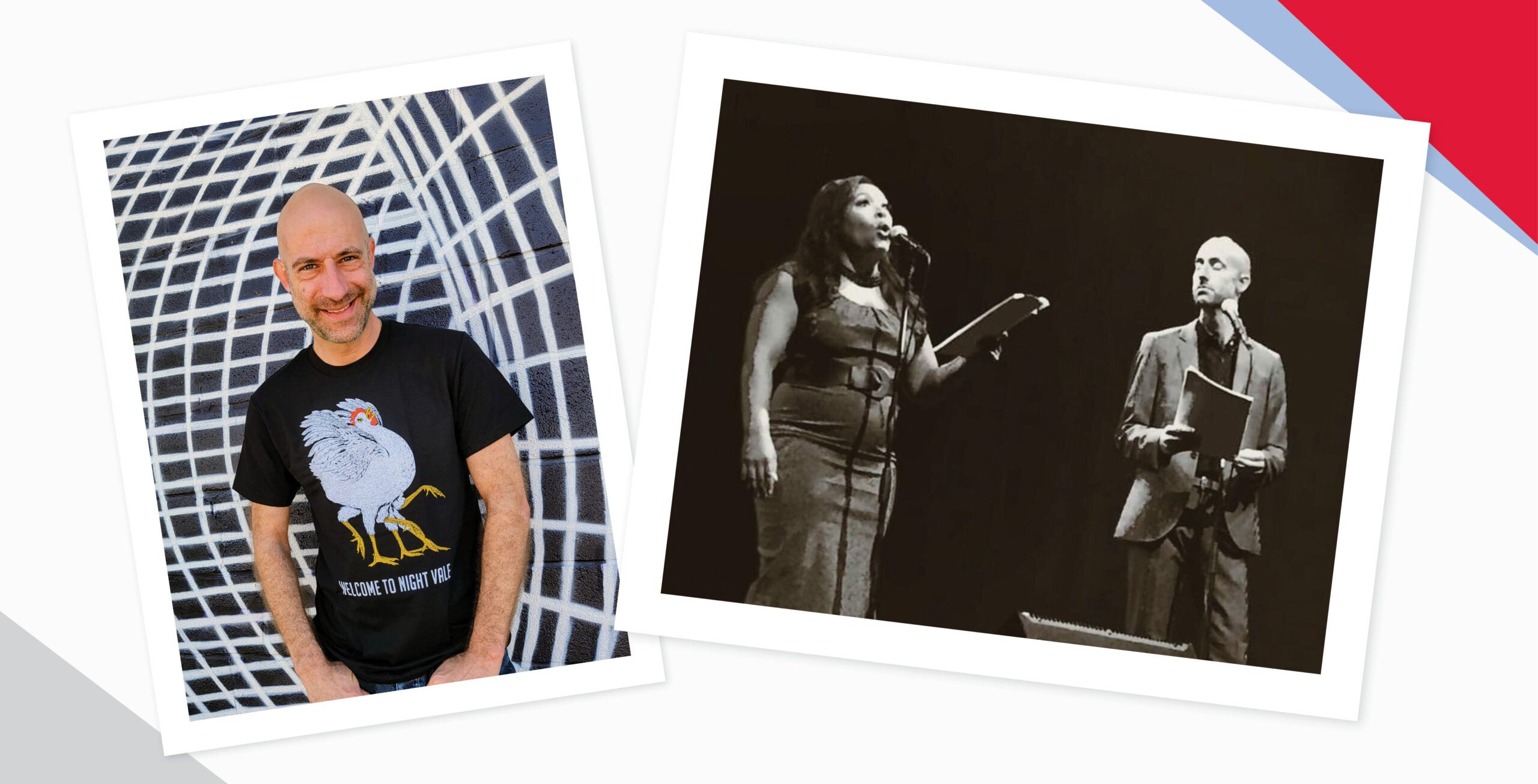
For the dear listeners of “Welcome to Night Vale,” a fiction podcast following the outlandish goings-on of the titular “friendly desert community,” radio host Cecil Palmer’s voice is the foundation of the world(s) explored within. From the sheriff’s secret police to the ominous glow cloud to the forbidden dog park and beyond, Night Vale’s existential eccentricities are underpinned by the soothing musings Cecil utters into his microphone.
As the voice behind Cecil Palmer in “Welcome to Night Vale,” Cecil Baldwin ’01 capitalizes on the experimental sensibilities he’s been building since his time studying Theatre at Bradley University. Empowered by both academic and theatre scholarships, the Knoxville, Tenn. native knew Bradley was a no-brainer.
“Bradley University seemed to be the sweet spot—not too far away, but far enough,” Baldwin said. “The campus is really lovely and compact and walkable.”
Obliged by his scholarship to audition for all Bradley mainstage shows, Baldwin kept busy performing and catching productions in Chicago. While he often ended up playing smaller roles that afforded him time to observe and absorb, the more experimental productions in Bradley’s black box allowed him to create more avant-garde work, where he really found his niche.
“I’m forever grateful for Bradley University and the opportunity to feel like I could try and fail, try and succeed, and just try all sorts of things. I think that’s what a good theater education should do.”
After graduating, Baldwin got an apartment in Chicago with two Bradley Theatre alumni and set forth into somewhat familiar territory.
“When I was at Bradley, I would roadtrip up to Chicago for an 8 o’clock show somewhere, then I would go see the avant-garde troupe The Neo-Futurists’ late show. Their premise was pretty simple—the performers are where they are, they are who they are, and they’re doing what they’re doing,” Baldwin explained. “It’s autobiographical, they don’t play characters, and everything is generated by the ensemble.”
Eventually moving to New York City, it was the seed of experimental theatre planted at Bradley and fostered by The Neo-Futurists shows in Chicago that would blossom into Cecil Palmer of “Welcome to Night Vale.” Baldwin, after securing a position in the The Neo-Futurists of New York City, wrote a play about being a struggling voice actor in which he offers to record outgoing voicemails for members of the audience—this garnered the attention of a non-traditional writer in the area that was struggling with getting his work published in a traditional format. This writer, Joseph Fink, had an idea for a fiction podcast that revolved around a community radio host.
“He let me borrow a $25 Snowball microphone that he wrapped up in a t-shirt,” Baldwin said. “We talked about the themes and style of the show being very David Lynch and existential in its comedy. I think we made ‘Welcome to Night Vale’ for a good year-and-a-half before anybody paid attention. I couldn’t get my mom to listen to it—even explaining to people what a podcast was and how you found it was kind of difficult back in 2012.”
Eventually though, through social media platforms like Twitter and Tumblr, the listener base began to grow exponentially.
“We went from being relatively unknown to being the most downloaded podcast in the world in the span of three months,” Baldwin said.
Around this time, fellow Bradley alumna and voice actor Symphony Sanders visited New York City. Baldwin introduced her to the show writers, and she ended up becoming the longtime voice of Tamika Flynn, a character on the show and on Night Vale tours.
For almost 20 years, Baldwin lived the grind in New York City, auditioning, recording, performing with The Neo-Futurists on the weekends, and sometimes waiting tables. After the COVID-19 pandemic, however, he moved to Asheville, N.C. to settle down. Though still the voice of Night Vale, his day-to-day has evolved from pounding the pavement.
“Honestly, it’s a lot of emails. It’s a lot of scheduling. It’s a lot of getting on Zoom calls and recording and sending invoices,” Baldwin said.
Getting to this point of stability didn’t come easy for Baldwin. For those looking to follow in his footsteps and find work as an actor, his recommendation to explore across disciplines reads like a description of Bradley’s ethos of convergence and cross-college collaboration.
“If you’re in a certain discipline—theater, dance, fine arts, whatever it is—pursue that. Get to know the people in that area, get to know that world, but also explore the other disciplines. Explore opera, explore architecture, because you never know where inspiration will come from,” Baldwin said.
–Jenevieve Rowley-Davis