We are currently sold out of spots for the 2026 Pickleball Tournament.
If you wish to join the waitlist, please email the Bradley Ticket Office, and we will contact you if a spot opens up.
Please note if you wish to enter as a team or individual. If you enter as an individual, you will be paired with another player.
A New Era of Recreation
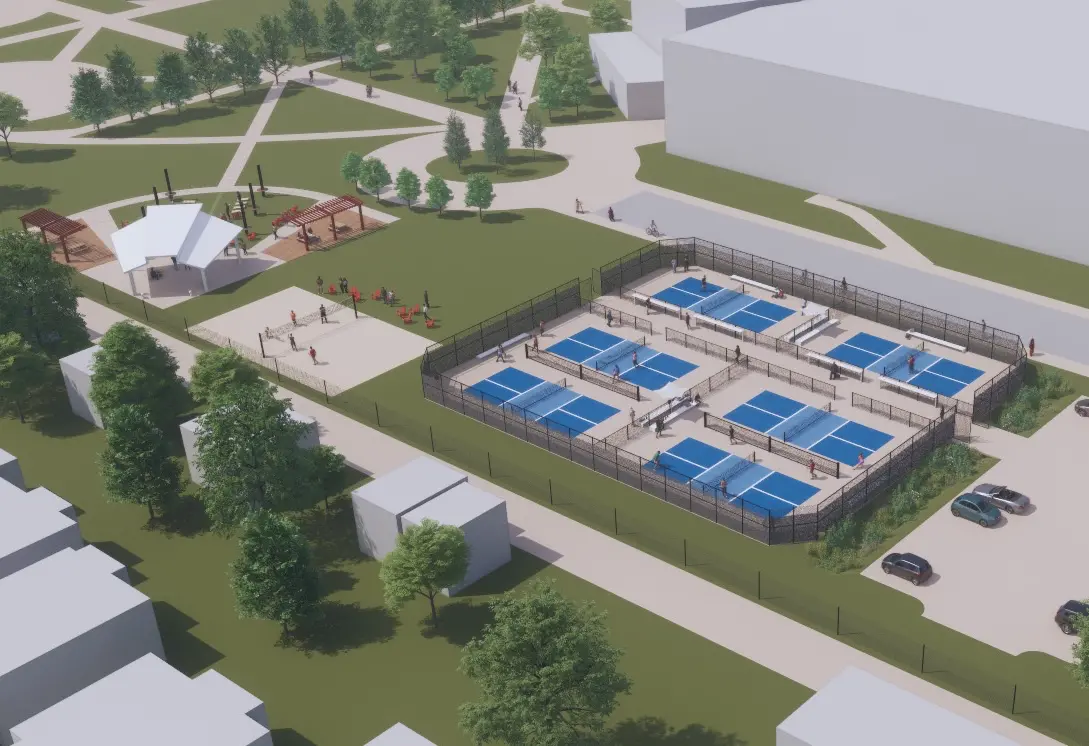
The event kicks off at 3 p.m. with a groundbreaking ceremony for our brand new outdoor recreation complex featuring state-of-the-art facilities designed for the entire Bradley community. Located adjacent to the Markin Recreation Center, this new complex will transform outdoor recreation at Bradley.
Event Schedule
3:00 pm
Groundbreaking ceremony for outdoor recreation complex
3:30 pm
Tournament check-in at Renaissance Coliseum
4:00 pm
Welcome from President Shadid
4:15 pm
Game time. Let the tournament begin!
What’s Included
3 Games
At least 3 guaranteed games
T-Shirt
Tournament t-shirt
Drinks
1 drink ticket for each registrant
*Must be 21+ with valid ID to purchase alcoholic beverages
Registration Options
Don’t miss your chance to compete, celebrate, and help shape the future of outdoor recreation at Bradley!
REGISTRATION DEADLINE: January 23, 2026
Bradley Students
FREE
Show your Bradley ID and play free! Don’t miss this exclusive opportunity.
Individual
$25
Perfect for solo competitors looking to join the action.
Team
$50
Bring your partner and compete together as a team.
Team + Paddles
$100
Team registration plus two Bradley-branded pickleball paddles to take home!
Questions? Contact [email protected]
Bradley Pickleball Tournament Rules
Game Overview
Pickleball is a simple paddle game played using a special perforated, slow-moving ball over a tennis-type net on a badminton sized court.
The ball is served underhand with or without bouncing it off the court and is served diagonally to the opponent’s service court.
Points are scored by the serving side only and occur when the opponent faults (fails to return ball, hits ball out of bounds, etc.).
The server continues to serve, alternating service courts, until server faults.
Service
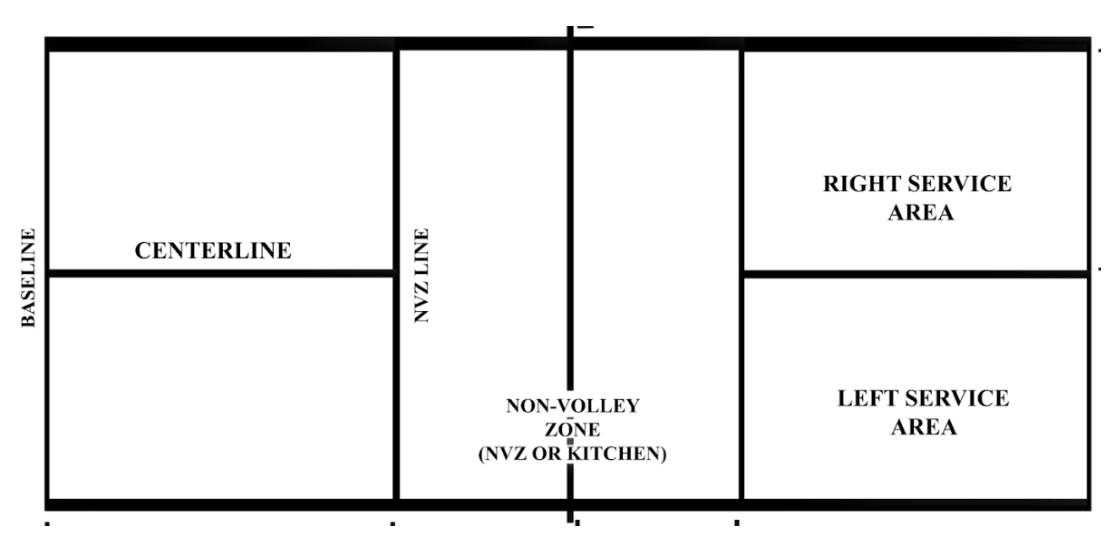
The server must keep both feet behind the baseline during the serve with at least one foot on the court surface or ground at the time the ball is struck. The serve must be made while the server’s feet are within the confines of the serving area. These confines lie behind the serving court baseline and on or between the imaginary lines extended from the court centerline and each sideline.
The serve must be made with an underhand stroke in order to contact the ball below the waist level. (The arm must be moving in an upward arc and the paddle head shall be below the wrist when it strikes the ball).
The ball must land in the opponent’s crosscourt (diagonally opposite court) service court. The serve must clear the net and the non-volley line and land in the opponent’s service court. The serve may land on any service court line except the non-volley line.
Service Fault – During the service, it is a fault if:
- The server misses the ball when trying to hit it.
- The served ball touches any permanent object before it hits the ground (ex. Ceiling, wall, lights, net posts, etc.).
- The ball touches the server or partner of the server.
- The ball lands on the non-volley line.
- The served ball lands outside the service court.
Service Let – The serve is considered a let and will be replayed if:
- The serve touches the net, strap or band and is otherwise good and lands in the service court.
- The ball is served when the receiver is not ready
- Any player calls a timeout because an object has come onto the court
NOTE: There is no limit to the number of lets a server may have
Scoring
Only the serving team can score points. Matches are played in sets of games. Best two of three games win the match.
Points are scored by legally serving the ball that is not touched by the opponent (an ace) or by winning the rally (faulting by the opponent).
For games one and two, the first side scoring 11 points and leading by at least a 2-point margin wins. If both sides are tied at 10 points, then play continues until one side wins by 2 points, there will be a cap of 18 for the first two games. In game three, first side scoring 7 and leading by at least 2 with a cap of 11 points will be the winner.
The Receiver
The receiver is the player diagonally opposite the server. In doubles, this position corresponds to the player’s score and starting position. There is no restriction on the receiver’s position.
Double-Bounce Rule
The serve and the service return must be allowed to bounce before striking the ball. That is, each side must play a groundstroke on the first shot following a serve. After the initial ground strokes have been made, play may include volleys (i.e. ball not hitting the ground before it is legally struck).
10-Second Rule
The “10-second rule” applies to both the server and receiver, each of whom is allowed up to 10 seconds after the score is called to the server, or be ready to receive. It is the server’s responsibility to look and be certain the receiver is ready to receive serve.
Service Sequence
The service always starts in the right-hand court and alternates from right to left to right, etc., as long as the server holds serve.
The server must serve to the crosscourt (court diagonally opposite) service court. There is no restriction on the position of the server’s partner.
The starting server will always be on the right side, the order of servers may change.
The team serving the initial serve of the game can commit only one fault before service is passed on to the opposing team. After that, each team member serves until that player loses the serve when the team commits a fault. After both players have lost their serves, the serve passes to the opposing team.
The server will alternate between right and left service courts upon scoring a point. After the first server’s team faults, the second server will continue to serve from that server’s last side position and then alternate positions as long as the serving team continues to win points.
If the ball is served by the wrong team member or from the wrong court, the service is a fault. If the fault was caused by the first server, then the first service is lost and the correct second server serves from the correct service position. If the fault was by the second server, then it is a side out. A point made from an incorrect service position or an incorrect server will not be retained unless play has continued and another point has been scored or the opposing team has served.
Side Selection and Rotation
Rock-Paper-Scissors (best of three) will determine first choice of service or side.
Sides and initial service will be switched upon completion of each game.
Sides will be switched in the third game after the first team reaches six points. Serve remains with the player holding serve.
Non-Volley Zone
The non-volley zone is the area of the court bounded by the two sidelines, the non-volley line and the net. This area is referred to as the “kitchen”
A fault will be declared if, in the act of volleying the ball, a player or anything the player is wearing or carrying touches the non-volley zone or touches any non-volley line.
A fault will be declared if, in the act of volleying the ball, the player’s momentum causes the player or anything the player is wearing or carrying the touch the non-volley zone or touch any non-volley line.
All volleys must be initiated outside of the non-volley zone. A maneuver such as standing within the non-volley zone, jumping up to hit a volley, and then landing outside the non-volley zone is prohibited. If a player is inside the non-volley zone for any reason, that player cannot volley the return until both feet are on the court surface outside the non-volley zone.
A player may stay inside the non-volley zone to return balls that bounce.
Any violation, or fault, will result in either a point (if violator was the receiver of the server) or lass of service (if violator held service).
Miscellaneous
Carry and Double Hits – Balls hit during one continuous, single-direction stroke are legal, even though they may be unintentionally hit twice or carried. Only when there is a definite second push by the player does the shot become illegal.
Switching Hands – A paddle may be switched from hand to hand at any time. Two-handed shots are also legal.
Playing Surface
Pickleball is played on a pickleball court. A diagram of the court is shown below.