


Construction
Bradley’s Bachelor of Science in Construction (BSC) equips you with the technical and business skills to thrive in commercial, industrial, residential, and heavy civil construction. You’ll learn project management, cost estimating, scheduling, safety, and project controls—plus earn a built-in business administration minor covering economics, finance, law, and marketing.
Hands-on experience, real-world projects, and a senior capstone ensure you graduate ready to lead in the construction industry.
Experiential Learning
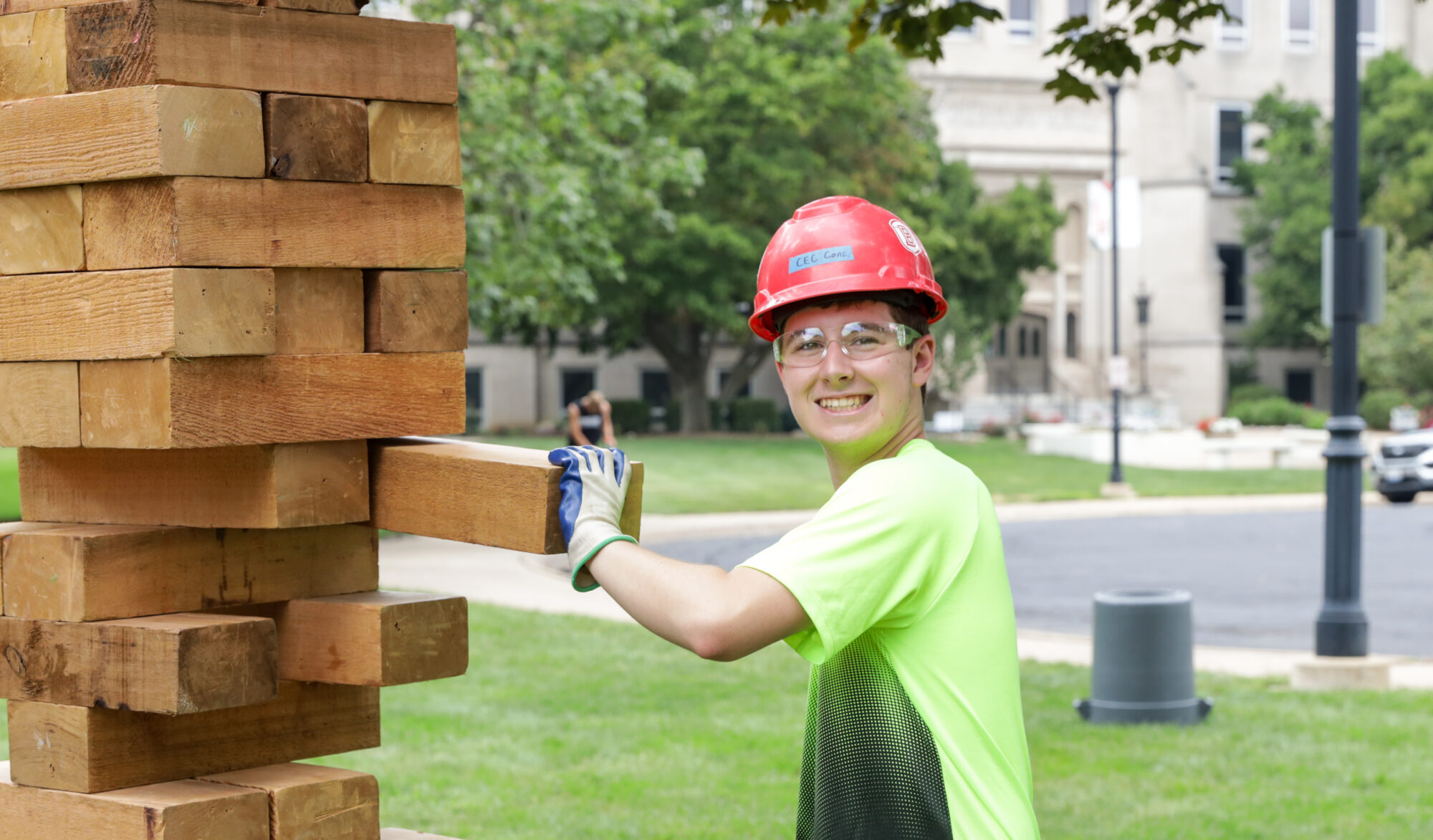
Bradley’s Bachelor of Science in Construction program immerses students in real-world learning through hands-on experiences, mentorship, and industry engagement. Highlights include:
Industry Connections & Networking
Hands-On Learning
Competitions & Research
Field & Global Experience
Program Details
Bachelor of Science in Construction (BSC)
Accredited by the American Council for Construction Accreditation (ACCE)
Mission
Produce graduates who possess a keen awareness of the national and global dimensions of the construction industry, leadership skills required to serve our society, and the technical knowledge to pursue multiple career paths including advanced degrees.
Program Educational Objectives (PEOs)
Objective I – Leadership in Construction: Graduates understand the need for teamwork, communication skills, integrity, good citizenship, and service. They have the needed knowledge to become leaders in the construction industry.
Objective II – Professional Achievement: Graduates have the needed understanding of ethical responsibilities, certification, the necessity for continuing education, and contemporary issues required for placement and career advancement.
Objective III – Globalization: Offer programs to ensure that graduates have the needed awareness of global construction issues and cultures to help them thrive in an emerging world market.
Objective IV -Industry Partnerships: Partner with the construction profession to offer an innovative program that promotes cultural diversity and responds to the needs of the profession and society in the areas of sustainability, infrastructure, and emerging technology.
Student Outcomes (SOs)
- Create written communications appropriate to the construction discipline.
- Create oral presentations appropriate to the construction discipline.
- Create a construction project safety plan.
- Create construction project cost estimates.
- Create construction project schedules.
- Analyze professional decisions based on ethical principles.
- Analyze methods, materials, and equipment used to construct projects.
- Apply electronic-based technology to manage the construction process.
- Apply basic surveying techniques for construction layout and control.
- Understand different methods of project delivery and the roles and responsibilities of all constituencies involved in the design and construction process.
- Understand construction accounting & cost control.
- Understand construction quality assurance & control.
- Understand construction project control processes.
- Understand the legal implications of contract, common, and regulatory law to manage a construction project.
- Understand the basic principles of sustainable construction.
- Understand the basic principles of structural behavior.
- Understand the basic principles of mechanical, electrical and plumbing systems.
Summary of Achievement of Student Learning Outcomes (SLOs) and Objectives
Bradley University’s Admission Requirement
The Bradley University Undergraduate Catalog describes the admission standards and procedures for entering as First-year Student and for Transfer Admission. These requirements apply to all programs, including the Construction program.
Construction Program CIP code
Classification of Instruction Program (CIP)
2023 to Present
CIP Code 14.3301 (STEM series) – A program that prepares individuals to apply scientific, mathematical, and management principles to the planning, design, and building of facilities and structures. Includes instruction in civil engineering, structural principles, site analysis, computer-assisted design, geology, evaluation and testing, materials, contracting, project management, graphic communications, and applicable laws and regulations.
Prior to 2023
CIP Code 52.2001 – A program that prepares individuals to manage, coordinate, and supervise the construction process from concept development through project completion on timely and economic bases. Includes instruction in commercial, residential, mechanical, highway/heavy civil, electrical, environmental, industrial, and specialty construction; facilities management; project planning; budgeting and cost control; logistics and materials management; personnel management and labor relations; site safety; construction contracting; construction processes and techniques; organization and scheduling; and applicable codes and regulations.
Annual Student Enrollment and Graduation Data
|
Year |
Fall Enrollment |
Graduates in Year |
|---|---|---|
|
2022-2023 |
68 |
19 |
|
2021-2022 |
73 |
16 |
|
2020-2021 |
62 |
19 |
|
2019-2020 |
61 |
19 |
|
2018-2019 |
71 |
22 |
|
2017-2018 |
74 |
23 |
|
2016-2017 |
76 |
26 |
Degree Options
Students may apply to the 4+1 Master of Science in Civil Engineering program while completing their Construction bachelor’s degree. Applications are considered in the spring of junior year or the fall of senior year. Students will not be eligible to apply after the first day of the spring semester of their senior year.
Career Opportunities
Bradley’s BSC degree prepares you for a wide range of dynamic careers, including project management, project engineering, estimating, scheduling, facility management, and field supervision.
As a construction professional, you’ll play a vital role in shaping the infrastructure and communities where we live, work, and play. This is a diverse, high-impact field at the heart of our built environment—with opportunities to make a tangible difference every day.