


Home / Academics / Programs / Minor / Women’s and Gender Studies
Women’s and Gender Studies
The Women’s and Gender Studies minor is an interdisciplinary program which takes gender as its central category of analysis in the examination of social, cultural, economic, and aesthetic systems. Courses focus on the social construction of gender identity, gender relations, and gender systems. Through discussions and engaged learning experiences, you study how gender intersects with multiple and complex categories of identity, including race, ethnicity, class, sexuality, and nationality. A research-focused capstone seminar allows you to explore topics in more depth.
Experiential Learning
Beyond classroom experiences, the minor gives you experiential learning opportunities for internships in the Bradley and Peoria communities, faculty-student collaboration research, campus leadership through different student organizations, advocacy through gender justice action projects, networking and professional activities related to diversity and gender equality issues
Networking Opportunities
Several student organizations on campus are affiliated or work close related with WGS such as:
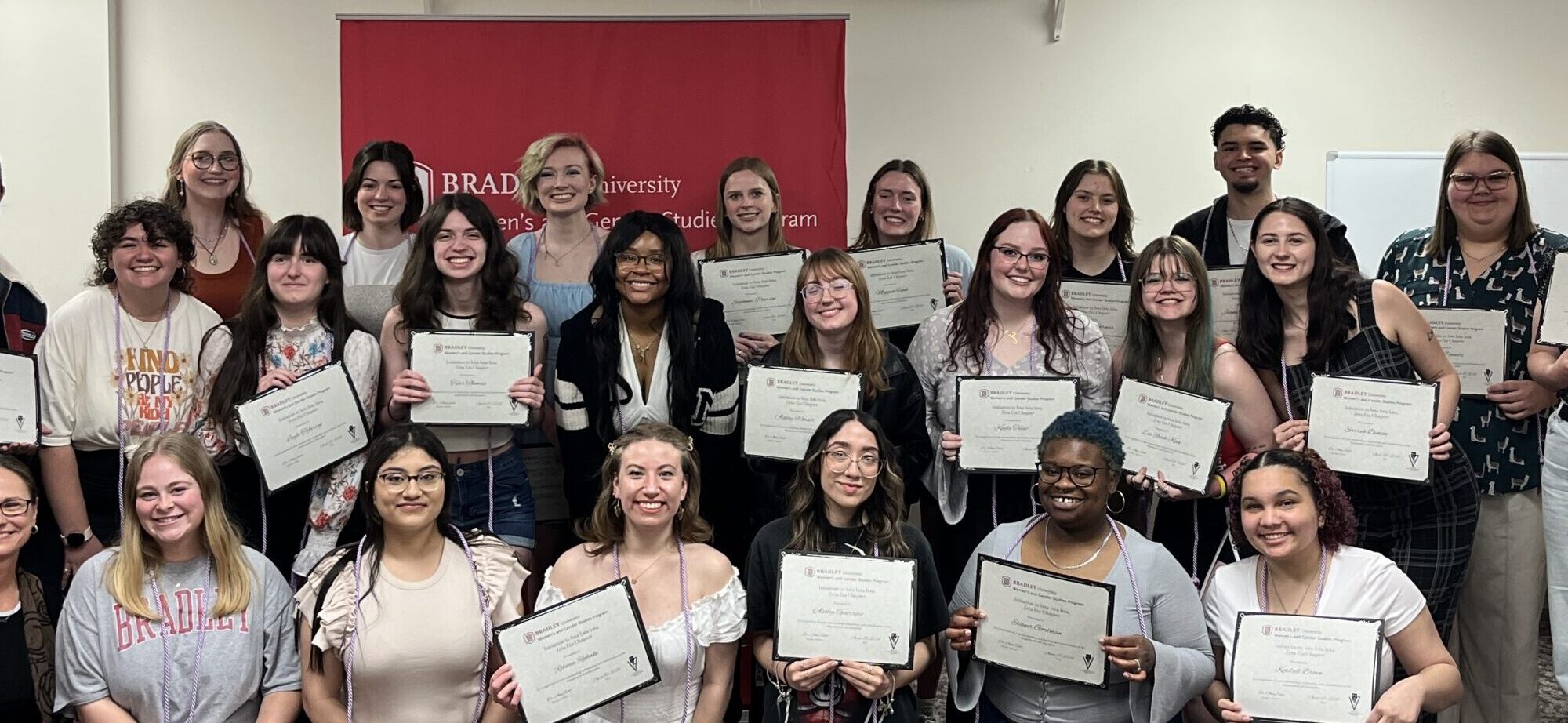
- Iota Iota Iota (Triota) an academic feminist honor Society in Women’s, Gender, & Sexuality Studies that encourages and promotes feminist scholarship, achievement, and success.
- S.H.E. Speaks (Sisterhood of Humanistic Equality) is a club intending to create a public forum to discuss various topics of feminism where students to speak about their experiences, share their backgrounds, and express differences using intergroup dialogue. It hosts guest speakers and book club meetings.
- Generation Action Planned Parenthood BU is in partnership with the Peoria Planned Parenthood and the different Generation Action chapters at other colleges. Generation Action organizes events on campus and in the community “to raise public awareness about reproductive health and rights, educate young people about sexual health, create lasting change, and advocate.” The goal is to create fundamental equality and justice for all while learning how to communicate, work together, and build an understanding of marginalized communities.
- Queer Coalition is a student organization intending to educate and advocate for students members of the LGBTQ+ community. The members go into WGS and ETE classes to lead workshops on diversity and inclusion. They also work on activism and advocating for students that are part of underserved and marginalized communities.
Highlights
The students who produce the best research projects in the capstone seminar WGS 400 Directed Research not only present their work at the Bradley Student Scholarship Expo, but also at the Annual Women’s, Gender, and Sexuality Studies Student Research Symposium at Illinois State University and other conferences.
The gender justice action projects produced also in WGS 400 or 300 have made an impact on campus in different ways. Among the projects that have become an annual event are Talk Back the Night in April in which students, faculty, staff, community raise awareness against violence and show their support to survivors of sexual assault and the Lavender Graduation that is the LGBTQ+ affinity graduation event, in which LGBTQ+ students are celebrated for the unique societal hurdles they have overcome.
WGS minors often praise the sense of community, the knowledge and tools in vocabulary, categories of analysis, theoretical approaches that the introductory course (WGS 200) and the capstone seminar (WGS 400) give them. Moreover, students recognize how these courses are a forum to express themselves and a platform of empowerment, in which they discover that all of us can be activists and changemakers through gender justice action.
Career Opportunities
- In the health care area, employers and graduate schools are looking for individuals who have a better understanding of how health care is affected by our social constructions of gender.
- In education, teachers and instructors who have a WGS minor have better results in empowering students from underserved and marginalized populations.
- NGO and non-profits seek constantly directors and managers whose WGS training influence their work ethics and philosophy.
Program Details
Non-monetary awards:
- Be the Change Campus Activism Award (certificate)
- Smash the Patriarchy Community Activism Award (certificate + framed art)
- Outstanding WGS Intern (certificate)
- Outstanding WGS 400 Paper (certificate)
Scholarships:
Bonnie Gordon Memorial Scholarship
This award was created in memory of Bonnie Gordon, the director of the Women’s Studies Program at Bradley University from 1990 until her tragic death in 1993. A women’s historian, her research focused on the medical problems faced by French women workers in the state match industry. The Scholarship was endowed by donations from Gordon’s husband, David Hedin, who is a physicist, and her parents, Stanley and Sylvia Gordon, with additional contributions from friends and family. The Scholarship is awarded each year to an undergraduate student pursuing the minor in Women’s Studies, and majoring in History or a health related discipline The student is chosen based on scholarly achievements and commitment to women’s issues. One award of $1500 per academic year.
“My most impactful experience from WGS was my thesis. It was on the cultural and psychological support of doulas among brown and black people. (…) Ironically it was my first qualitative research project, and I apply it now that I am an evaluation consultant. (…) I just recently put it together that what I was doing back then (7 years ago) is what I do now.”
(Sojourner W. Psychology and Spanish majors, WGS minor)
“The stuff that I learned in my minor was honestly the most validating and enriching experience and I owe not only a lot of who I am today, but also the work that I do, to my minor. It really does shape how I walk in the world.”
(Mariela J. Psychology major, WGS minor)
“In my WGS thesis I explored the inequalities within medicine and how different communities are negatively impacted when seeking medical care in the medical field. (…) Health is important to every single person and ensuring that everyone has equal access and equal standards of care is extremely important. (…) My WGS research background has really prepared me for graduate school. (…) WGS classrooms are such community spaces in comparison to other classes.”
(G. French, Kinesiology and Health Sciences majors, WGS & Sociology minors)