


Home / Academics / Programs / Major / Military Science
Military Science
Training Tomorrow’s Army Leaders
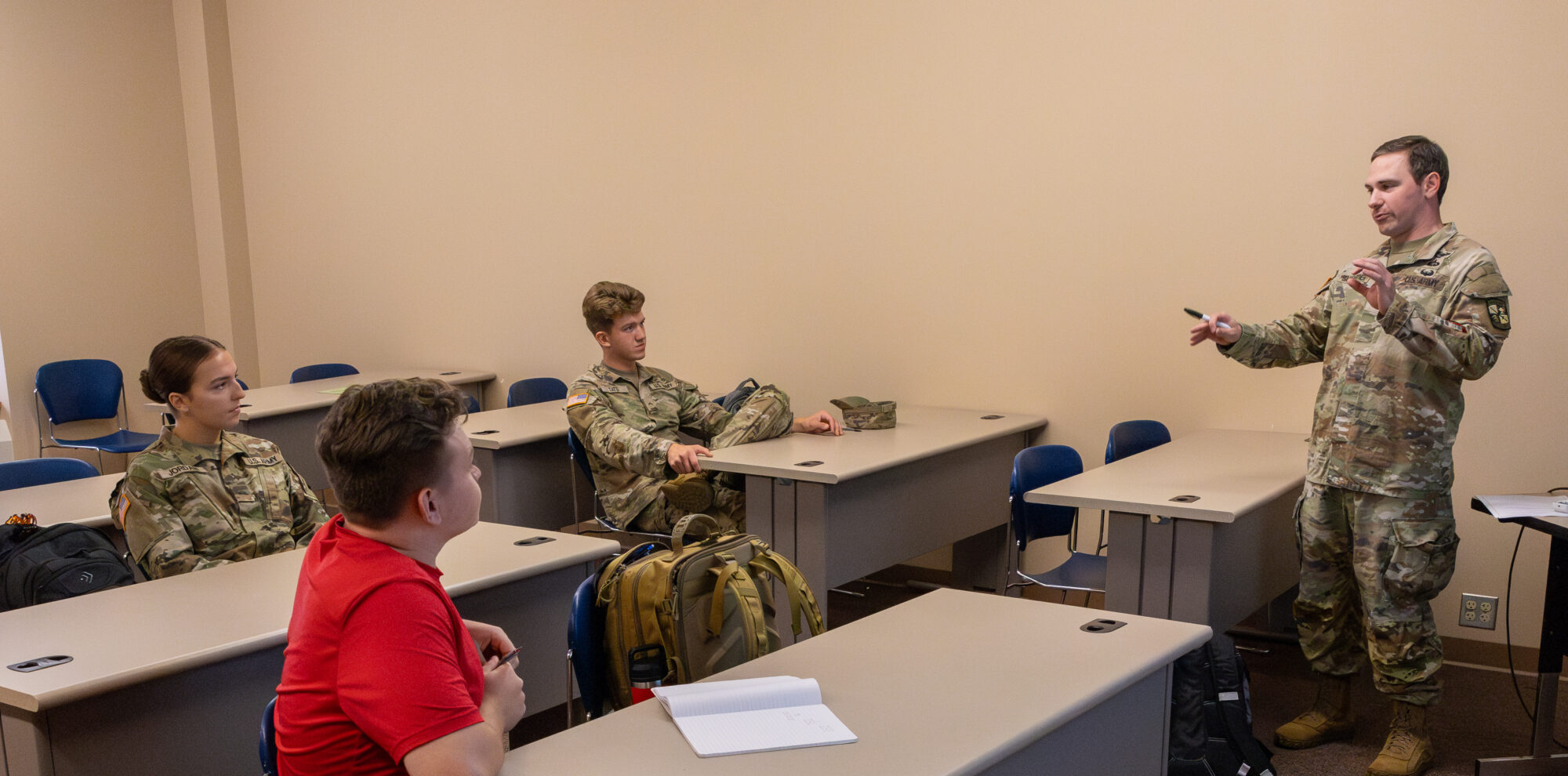
Army ROTC is Phase I of Army Officers’ training for the Active Duty, Army National Guard and Army Reserve. The first two years of Military Science classes can be taken with no commitment to the Army. Through classes and field training, Army ROTC provides you with the tools to become an Army Officer while you pursue a college degree.
About Army ROTC
The Army ROTC program is designed to be a four-year program of study that is completed concurrently with a student’s chosen academic major. However, the program can be completed in as little as two years. In order to earn constructive credit for the first two years of the program, students can attend the four week Army ROTC Cadet Initial Entry Training Course (CIET) at Fort Knox, KY, or show credit for completion of military basic training.
Students may participate in the first two years of Military Science with absolutely no military service obligation. Graduate students may also participate in the program by attending the Leaders Training Course or military basic training before entering the program.
Prior Service, National Guard and Reserve Soldiers
Our program is also open to prior service military veterans as well as soldiers currently serving in the National Guard and Reserve forces. Please see the links on this page for how you can join ROTC.
ROTC Alumni
- John Shalikashvili, Chairman of the Joint Chiefs (Bradley University, 1958)
- Colin Powell, Chairman of the Joint Chiefs, Secretary of State (City College of New York, 1958)
- Samuel Walton, Founder of Walmart (University of Missouri, 1940)
- Samuel Alito, Supreme Court Justice (Princeton, 1972)
- Lenny Wilkens, Most winning NBA coach (Providence College, 1960)
Program Details
A cross-enrollment agreement between Bradley University and Illinois State University (ISU) makes training in the Army Reserve Officers Training Corps (AROTC) available to qualified Bradley students who desire to earn appointment as commissioned officers in the United States Army. The goal of the AROTC is to commission college graduates into the Active, National Guard, and Reserve components of the Army. Military science classes are conducted on Bradley University’s campus in Peoria, Illinois and at ISU. Military science classes are recorded on students’ transcripts, and the grades received and semester hours of credit are counted as if they had been taken at Bradley. For more information, please contact the Registrar’s Office at (309) 677-3101.
To complete the basic course a student must complete MS 101, 102, 201, and 202, normally taken in that sequence, over a four-semester period. Exceptions are determined by law and may be discussed on an individual basis with the professor of Military Science at Bradley University. Entry into the advanced course requires successful completion of the basic course, basic camp or advanced placement, and acceptance by the professor of Military Science. The advanced course must be completed over a four-semester period, the usual sequence consisting of MS 301, 302, 401, and 402.
- MS 101: Intro: Army & Critical Thinking – 1 hr.
- MS 102: Intro: Profession of Arms – 1 hr.
- MS 150: Military Physical Conditioning – 0 hrs.
- MS 200: Leadership Laboratory – 0 hrs.
- MS 201: Leadership and Decision Making – 2 hrs.
- MS 202: Army Doctrine & Team Development – 2 hrs.
- MS 287: ROTC Independent Study – 0-3 hrs.
- MS 301: Training Management & Warfighting Functions – 3 hrs.
- MS 302: Applied Leadership in Small Unit Operations – 3 hrs.
- MS 401: The Army Officer – 3 hrs.
- MS 402: Company Grade Leadership – 2 hrs.
- HIS 326: Modern MilitaryForces and Institutions – 3 hrs.
- Advanced Cyber Education Internship (ACE)
- AMEDD Internship Program (AMEDDIP)
- Army Bands Internship
- Budget Analyst Internship
- Chaplainry Internship Program (CHIP)
- Cultural Property Protection Internship Program (CPPIP)
- CYBERSPACE (CIP)
- Defense Coordinating Officer/Element (DCO/E)
- Engineering Internships (EIP)
- Forensic Internship Program (FIP)
- Intelligence and Security Command Internship Program (INSCOMIP)
- Lawrence Livermore National Laboratory (LLNL) (PAID INTERNSHIP)
- Legal Internship JMTC (LIP)
- National Ground Intelligence Center (NGIC)
- Nurse Summer Training Program (NSTP)
- Rapid Equipping Force Internship Program (REFIP)
- Research Internship Program (RIP)
- Training Brains Operation Center (TBOC)
- US Army Global Civil-Military Emergency Preparedness Program (AGCMEP)
Extracurriculars
Ranger Challenge is often called the “varsity sport” of Army ROTC. One weekend every fall, our team attends a competition at Marseilles National Guard Training Center in LaSalle County, Illinois.
The Bradley University Ranger Challenge team competes against other schools in our region, including Northern Illinois University, University of Illinois – Chicago, Wheaton College, Olivet Nazarene College, Western Illinois University, University of Illinois – Champaign/Urbana, and Eastern Illinois University.
The Ranger Challenge teams consist of:
- A 5-person, co-ed team
- A 5-person, all female team
- A 9-person, co-ed team
Events
The Ranger Challenge team trains in the following basic infantry skills. These skills serve as events during the actual competition:
- Army Physical Fitness Test – Two minutes of push-ups, two minutes of sit-ups, and a timed 2-mile run
- First Aid Lane – Evaluate a casualty, 9-line MEDEVAC, and buddy carries
- Land Navigation – Six points during the day
- Ten kilometer road march – Timed event with with full combat load
- Assembly and disassembly of the M16A2 rifle and M9 pistol
- One-rope bridge
- Rifle competition
- Hand grenade lane
- Obstacle course
With their exceptional skill, endurance, ability, strength, and balance, the Bradley University ROTC Color Guard demonstrates their professionalism and military bearing to both Bradley University and our surrounding communities.
The Color Guard Team appears at many events, including:
- National Rifle Association banquet
- Military Ball
- Veteran’s Day Ceremony
- Daughters of the American Revolution ceremony
- Various Bradley University sporting events and parades
The team also travels to St. Louis every year to appear in the Missouri Valley Conference Championship.
History
In the United States military, the color guard (the word “color” refers to the U.S.A. flag) carries the National Color and other flags appropriate to its position in the chain of command. Typically these include a unit flag and a departmental flag (Army, Marines, Navy, Air Force, or Coast Guard). In addition to the flag bearers, who are positioned in the center of the color guard, two individuals carry rifles.
Since early history, flags and banners have been used by many armies in battle. They served several purposes: to identify units, to signal other units, and to act as a common point of reference for the movements of the soldiers in the unit, enabling them to keep formation. The flag was also an important symbol of the unit. The loss of a unit’s flag was not only shameful, but often losing this central point of reference could make the unit break up totally. To protect the flag, a detachment of soldiers was assigned to guard it.
The color guard renders honors when the national anthem is played or sung, when passing in review during a parade, and in certain other circumstances.
Army ROTC provides cadets with the opportunity to attend active-duty, skill-enhancement schools and specialized training courses with active Army personnel. Opportunities to participate in CAST promote leadership skills and can impact on retention of deserving cadets. Only those cadets with the highest potential for completing the course and commissioning will be selected.
Courses
The following courses are available for cadets to compete for:
- Basic Airborne Course (BAC)
- Air Assault School (AAS)
- Mountain Warfare Training (MWT)
- Cadet Troop Leader Training Program (CTLT)
- Cultural Understanding and Language Proficiency Program (CULP)
- Nurse’s Summer Training Program (NSTP)
Additional Resources
What is ROTC and it will pay for my college, right?
- Army ROTC is the Reserve Officers’ Training Corps and is phase one of Army Officers’ training. Army ROTC produces officers for the Active Duty, Army National Guard, and the Army Reserve. There are several financial incentives available for our students to compete for. All cadets are assessed on are the Scholar/Athlete/Leader (SAL) criteria.
- The minimum SAL criteria required to compete for our financial incentives are:
- SCHOLAR: cumulative GPA of a 2.5 on a 4.0 scale to include transfer GPA if you are a transfer student and either a 19 ACT score or a 1000 SAT score
- ATHLETE: 360 points (60 points in each event: 3-Repetition Maximum Deadlift; Standing Power Throw; Hand-Release Push-Up; Sprint-Drag-Carry; Plank; 2-Mile Run) on the Army Combat Fitness Test
- LEADER: any extracurricular activities you have participated in along with working, veteran, currently enlisted in the Army National Guard/Army Reserve, volunteering, community organizations, etc.
Is there a military obligation during college?
- The first two years of Army ROTC can be done without commitment. Students are encouraged to take this time and make an informed decision on whether or not this is the right path for them. They cannot enter in to the third year of the program without making a commitment to both the Army ROTC and the Army.
What happens upon completion of the 4-year ROTC program?
- The next step after college is to attend Phases II and III of Officers’ training. Time and location for this training is based on the branch (job) they were awarded.
By enrolling in ROTC, are you joining the Army?
- No. Students who enroll do not join the Army. They take a Military Science class each semester for which they receive credit. It is considered a college elective.
What is the difference between ROTC and Military Science?
- Military Science is the academic portion of ROTC. There are a total of 21 credit hours for Military Science. ROTC is comprised of the Military Science classes, physical training, training exercises, Basic Camp, Advance Camp, etc.
What can students expect to learn by taking ROTC?
- The leadership and management skills needed to become an Officer in the United States Army or to have a successful civilian career. During the first two years, your studies will include basic leadership development, basic military skills, and life skills. The last two years focuses heavily on leadership training, planning and executing major training events, and possessing the higher level of thinking required of a great leader.
What makes ROTC different from regular college management courses?
- Students in ROTC learn through a unique program that combines both classroom instructions with practical application through leadership labs. Our students learn through a “hands-on” approach.
How much time does ROTC take up weekly?
- Our philosophy is academics first and ROTC second so whatever time is required to be successful in school plus Military Science class, Leadership Lab, physical training, and any additional training or ROTC events taking place. Time requirements increase with responsibility.
- The first year class only meets one day a week for 50 minutes. The sophomore through senior class each meets two days a week and has a Leadership Lab as part of their curriculum.
Does ROTC offer scholarships?
- Yes. There are scholarship opportunities: High School, Federal, Nurse, and the Guaranteed Reserve Forces Duty Scholarships. For more information on our scholarships and eligibility requirements please visit our Financial Incentives page.
Can I get a scholarship after I contract?
- No. All scholarship offers must be awarded prior to contracting.
Is there summer training involved with Army ROTC?
- Yes. Basic Camp is conducted between first and sophomore years and Advance Camp is conducted between junior and senior years. Both are four weeks long and are conducted at Fort Knox, KY. *Basic Camp is not mandatory for all students.
If I’ve attended basic training do I need to take the Military Science I and II classes?
- No. While basic training gives you constructive credit for the first two years of Army ROTC it all depends on how many semesters you have remaining at the university. We highly recommend taking the classes so you stay aligned with your year group, get use to the culture of Army ROTC, and provide yourself as much time as possible to see if this is really the right path for you.
Can I have a life and family outside of the military?
- YES! Whether you elect to go Active Duty, Army National Guard or Army Reserve you can have a normal lifestyle. It should be of no surprise though that time will be spent away from friends and family for deployments (combat and humanitarian), training and schools. Active Duty posts have Morale, Welfare, and Recreation (MWR) sites that host family, single Soldier and community events.
- Did you find the answer you were looking for? If not, then text or call Mr. Sanford at 309-287-1529 or email at [email protected].
- Jeremy DeMarb
- Bradley University, Bradley Hall 219
814 N. Tobias Ln. Peoria, Illinois 61625 - 309-438-2849 (Office)
- 309-287-1529 (Cell)
- [email protected]