


Home / Academics / Programs / Masters / Civil Engineering (MS)
Civil Engineering (MS)
Bradley’s MS in Civil Engineering (MSCE) equips you with the expertise to design, build, and sustain the infrastructure of the future. Through a blend of advanced coursework and hands-on projects, you’ll gain skills in construction management, structural, environmental, and transportation engineering.
With a focus on sustainable design, smart infrastructure, and urban development, the program prepares you to tackle real-world challenges and lead innovation in a rapidly evolving industry.
Experiential Learning
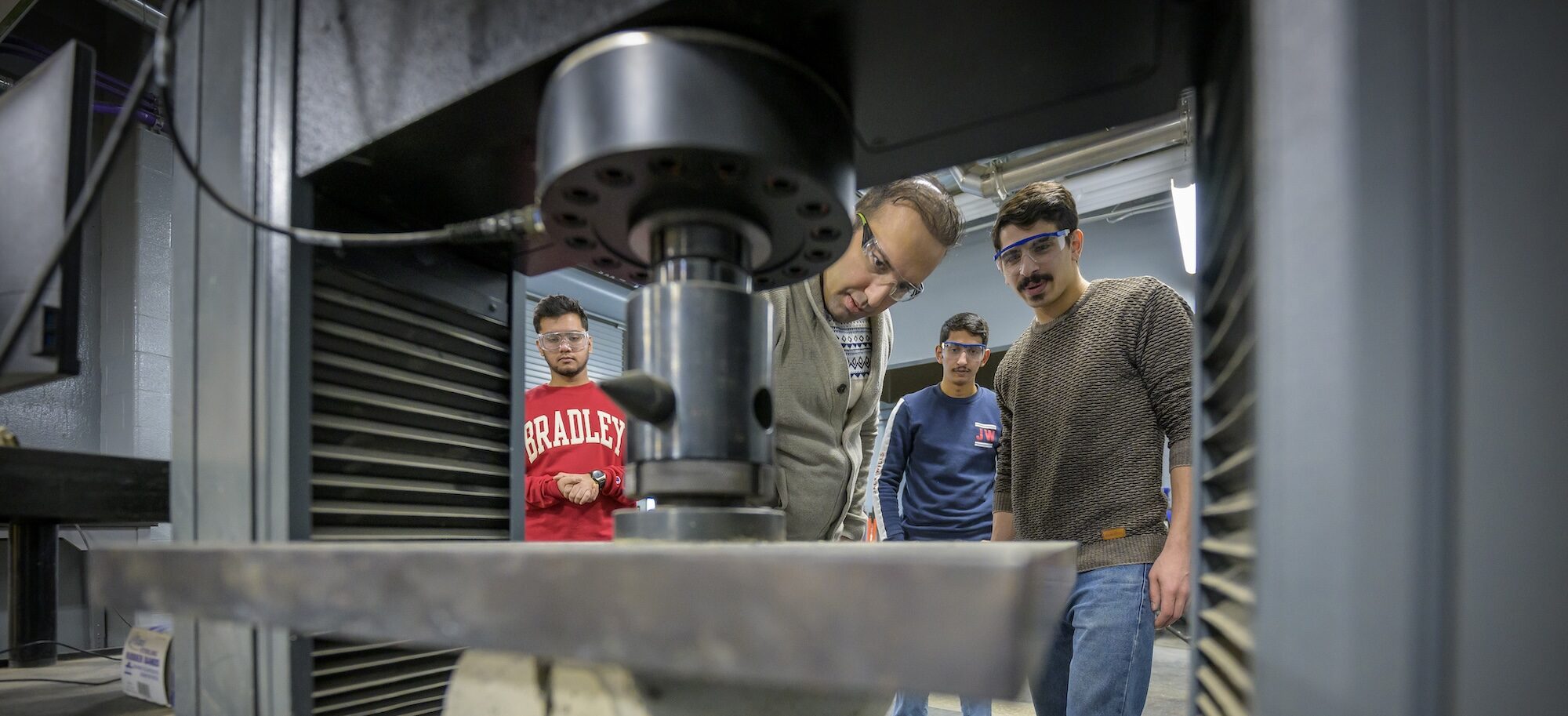
Bradley’s MS in Civil Engineering provides a flexible, hands-on education designed to prepare you for leadership roles in infrastructure, sustainability, and emerging technologies.
- Up to 40% of coursework can be tailored to fields like data science, business management, and logistics analytics.
- Internships and mentorships with faculty, alumni, and industry leaders offer hands-on experience and career guidance.
- Professional networking through organizations such as the American Society of Civil Engineers (ASCE), Associated General Contractors (AGC), Mechanical Contractors Association of America (MCAA), and Illinois Asphalt Pavement Association (IAPA) connects students with industry professionals.
- Opportunities to attend national conferences, including the Transportation Research Board (TRB) Annual Meeting, American Concrete Institute (ACI) Conference, International Conference on Computing in Civil Engineering (i3ce), and Construction Research Congress (CRC), provide exposure to industry advancements and global trends.
- Sponsored faculty research offers students experiential learning in emerging technology fields, with opportunities to present at national and international conferences.
- Collaborative projects tackle real-world challenges in infrastructure and sustainability.
- KEEN (Kern Entrepreneurial Engineering Network) integration develops an entrepreneurial mindset focused on curiosity, connection, and creating value.
- Field trips to industry facilities—including steel fabrication plants, asphalt and concrete plants, and active construction sites—help students apply classroom knowledge to real-world settings.
- Training in industry-standard engineering and construction software ensures students graduate with essential technical skills.
- Student organizations provide hands-on projects, leadership experience, and networking opportunities.
Career Opportunities
Our graduates are employed in various sectors such as government agencies, public works departments, consulting firms, contractors, serving private and government clients. They manage various aspects of construction projects, design infrastructure, and integrate ecological, social and economic impacts for sustainable design. Graduates from this program are pursuing careers in fields like:
- Construction: Overseeing construction projects from concept to completion.
- Structural: Designing and analyzing buildings, bridges, and other structures.
- Transportation: Planning and optimizing roadways, railways, and transit systems.
- Environmental/Water Resources: Developing solutions for water treatment, waste management, and pollution control. Designing and managing city water supply, flood control, and dams.